There is an affiliate link in this article
Most people who want to start a clothing brand from Africa get stopped before they start.
The reasons are always the same. You need to order inventory in bulk — minimum 50 pieces, 100 pieces, sometimes more — before you know if anyone will buy. You need a warehouse or somewhere to store stock. You need to handle international shipping yourself, figure out customs, manage returns. You need a website developer. You need a payment processor that actually works in Ghana or Nigeria or Kenya. You need startup capital you may not have.
And so the idea stays an idea.
Here is what changes when you understand how print on demand works through a platform like Fourthwall: you need none of those things. No inventory. No warehouse. No upfront capital. No developer. No shipping logistics. You design the product, connect it to global fulfilment, and sell worldwide — from your phone, from Accra, from Lagos, from Nairobi.
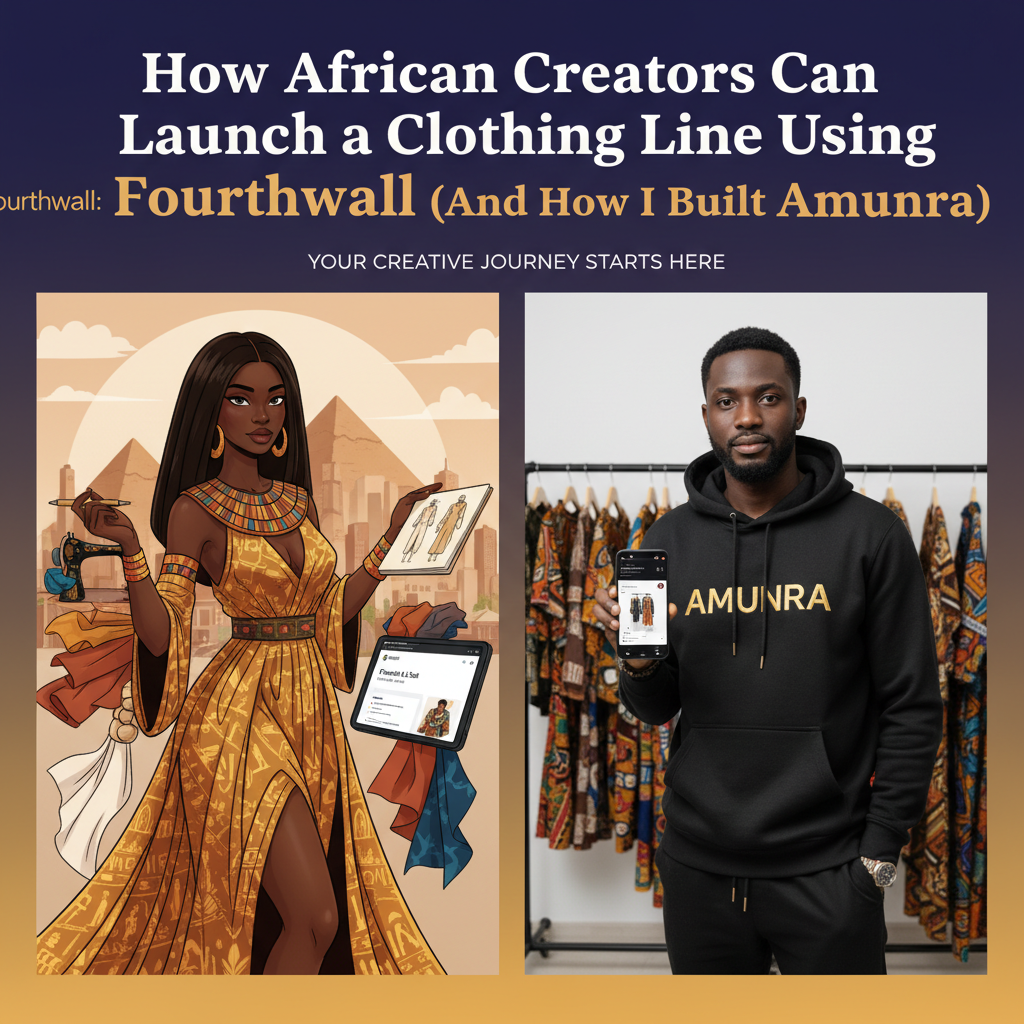
I know this because I built Amunra — a sun-inspired minimalist streetwear brand founded in Accra, Ghana — using exactly this model. Every piece is made to order, printed and shipped by manufacturing partners close to the buyer across the US, UK, EU, Canada, Australia, and Japan. And every 5 products sold funds one solar reading lamp for an off-grid household in rural Ghana. A clothing brand with a live public impact tracker, selling globally, run by one person from West Africa.
This guide covers both layers: the complete tutorial for any African creator who wants to launch a clothing line using Fourthwall, and the honest, detailed story of how Amunra came to exist — the decisions, the model, the challenges, and what I learned building it.
Table of Contents
- What Fourthwall Is and Why It Is Different
- Why Fourthwall Works for African Creators Specifically
- The Print-on-Demand Model Explained
- The Amunra Story: Why I Built a Clothing Brand From Accra
- Step 1 — Finding Your Brand Concept and Mission
- Step 2 — Setting Up Your Fourthwall Account
- Step 3 — Designing Your Products (No Design Experience Needed)
- Step 4 — Choosing the Right Products and Blanks
- Step 5 — Building Your Store on Fourthwall
- Step 6 — Writing Product Pages That Sell
- Step 7 — Setting Up Your Custom Domain
- Step 8 — Connecting Payment and Payouts for African Sellers
- Step 9 — Pricing Your Products Correctly
- Step 10 — Setting Up Your Impact Model (If You Have One)
- Step 11 — Launching: How to Get Your First Sales Without a Following
- Step 12 — Marketing Your Clothing Brand From Africa
- Understanding Fulfilment, Shipping, and Returns on Fourthwall
- The Numbers: What a $49 Tee Actually Earns You
- Scaling: From First Sale to a Real Brand
- Common Mistakes African Clothing Brand Founders Make
- Frequently Asked Questions
What Fourthwall Is and Why It Is Different
Fourthwall is a platform that lets creators build a fully branded online store — with a custom domain, their own design, and their own product catalogue — powered by print-on-demand fulfilment on the backend.
It was built primarily for content creators — YouTubers, podcasters, streamers, and online personalities who want to sell merchandise to their audiences. But what makes it genuinely useful for African brand builders is what it does underneath: it connects your store to a global network of print-on-demand manufacturing partners who print, pack, and ship your products to customers around the world — without you ever touching the inventory.
How It Compares to Other Options
Fourthwall vs Shopify: Shopify is more flexible but requires significantly more technical setup, a monthly fee ($39+/month), and you still need to find and integrate a print-on-demand supplier (Printful, Printify) separately. Fourthwall has print-on-demand built in, no monthly fee, and a simpler setup — better for first-time brand builders.
Fourthwall vs Printify/Printful with your own site: Using a separate print-on-demand service with your own site gives you more control but more complexity. Fourthwall wraps both the storefront and the fulfilment into one platform.
Fourthwall vs Redbubble or Merch by Amazon: Those are marketplaces — your products sit alongside thousands of other sellers and you have limited branding control. Fourthwall gives you a completely branded store that looks like your own website.
Fourthwall vs Teespring/Spring: Fourthwall is more premium and gives significantly more design and branding control. The store looks like a real brand, not a merch page.
What Fourthwall Provides
- A fully hosted, brandable online storefront with your own domain
- Built-in print-on-demand product catalogue (t-shirts, hoodies, hats, accessories, and more)
- Global fulfilment through manufacturing partners near your buyers
- Multi-currency support (USD, EUR, GBP, CAD, AUD, and more)
- Built-in checkout, payment processing, and order management
- Customer email collection and basic CRM
- No monthly fee — Fourthwall takes a percentage of each sale instead
- Custom pages (About, Impact, FAQ, Contact) beyond just the product catalogue
What Fourthwall Does Not Provide
- You cannot source custom fabric or use your own manufacturer through Fourthwall — the product catalogue is limited to what their print-on-demand partners produce
- Production quality is good but not identical to a luxury fashion house — understand the difference between print-on-demand and bespoke manufacturing before positioning your brand
- You do not control the shipping timeline — fulfilment typically takes 3–7 days production time plus 2–5 days shipping, so total delivery is usually 5–11 business days
Why Fourthwall Works for African Creators Specifically
The barriers that typically stop African entrepreneurs from entering the global apparel market are almost entirely eliminated by the print-on-demand model through Fourthwall. Here is the specific breakdown.
No Inventory Capital Required
Traditional clothing brand launch: you need to order 100–500 units upfront, pay for blank garments, pay for printing, store everything, and hope it sells. For a first-time founder in Ghana or Nigeria, this represents a significant financial risk often $2,000–$10,000 before a single sale.
Fourthwall print-on-demand: you pay nothing upfront. Products are manufactured after the customer pays you. Your cost is deducted from the sale. You keep the margin.
No Shipping Infrastructure Needed
You do not pack boxes. You do not queue at the post office. You do not negotiate with DHL Ghana or handle customs documentation for international orders. Fourthwall’s fulfilment partners — located in the US, UK, EU, Australia, Canada, and Japan — print and ship from close to the buyer. A customer in London ordering from Amunra gets their tee shipped from a UK facility. A customer in California gets theirs from a US facility. You manage none of this.
Payment in Hard Currency
Fourthwall processes all payments in the buyer’s currency (USD, EUR, GBP, etc.) and pays you out in USD or EUR. For an African founder, this means your income is denominated in stable hard currency, which you receive through Payoneer or bank transfer — not dependent on local payment infrastructure.
A Global Store That Looks Professional From Day One
A Fourthwall store with a custom domain (wearamunra.com), a brand logo, product photos, and a coherent design aesthetic looks indistinguishable from any other direct-to-consumer clothing brand. A buyer in New York or Berlin does not know or need to know that the founder is in Accra. What they see is the brand, the product, and the mission — all of which compete on merit.
Multi-Currency Display
Fourthwall automatically displays prices in the buyer’s local currency. A UK buyer sees prices in GBP. An EU buyer sees EUR. A Canadian sees CAD. This removes one of the most common friction points in international e-commerce — buyers abandoning carts because they have to mentally convert prices.
The Print on Demand Model Explained
Before building anything, you need to understand exactly how print-on-demand works — the economics, the process, and the limitations. Most people who fail at print-on-demand clothing do so because they misunderstood one of these three things.
The Process, Order by Order
- A customer visits your store and places an order for, say, a $49 oversized tee
- Fourthwall processes the payment and deducts their platform fee
- The order is automatically sent to the closest fulfilment partner (based on the customer’s shipping address)
- The fulfilment partner prints your design onto the blank garment you selected
- They pack and ship the order directly to your customer under your brand’s packaging
- You receive the profit margin (sale price minus base cost minus Fourthwall’s fee) in your payout account
You see none of this except the order notification and the deposit. The customer sees your brand.
The Economics of Print on Demand
Here is where you need to be honest with yourself about the numbers.
Print-on-demand has higher base costs per unit than bulk manufacturing. A premium organic cotton oversized tee from a print on demand supplier costs approximately $18–$25 base cost depending on the supplier, the blank, and the complexity of the print. That same tee from a bulk manufacturer in China or Bangladesh at 500 units might cost $6–$10.
This is the trade-off: no inventory risk, no upfront capital, global fulfilment — but thinner margins unless you price appropriately.
At Amunra, tees are priced at $49. The base cost for the Stanley/Stella GOTS-certified organic blank plus printing is approximately $22–$25. After Fourthwall’s fee and payment processing, the margin per sale is approximately $15–$20 per unit. Not the margins of a bulk manufacturer, but a real income without any inventory risk.
The way print-on-demand brands build sustainable income is not through high margin per unit — it is through volume, brand loyalty, repeat purchases, and the absence of the capital risk that kills traditional clothing brands.
The Quality Question
Print-on-demand quality has improved significantly. The blank garments available through Fourthwall include genuinely premium options — Stanley/Stella GOTS-certified organic cotton, Gildan premium blanks, Bella+Canvas — that compete with mid-tier to high-tier retail quality. The printing technology (Direct-to-Garment, DTF, screen printing depending on the supplier) produces durable, professional results when the design file is prepared correctly.
Amunra’s Signature Collection uses the Stanley/Stella Unisex Organic Oversized T-Shirt — GOTS-certified organic cotton, OEKO-TEX Standard 100 certified, PETA-Approved Vegan. This is genuinely premium fabric, certified to an international standard, that a buyer in London would expect from a $49 tee.
The limitation is in the print placement options and customisation. You cannot do, for example, all-over prints, complex embroidery, or custom woven labels through standard print-on-demand — at least not through basic Fourthwall integration. For Amunra’s minimalist design language, the standard placement options are sufficient. For a brand requiring more complex manufacturing, you would eventually need to move beyond print-on-demand.
The Amunra Story: Why I Built a Clothing Brand From Accra
Amunra was not born as a business idea. It was born as a question.
Why should something as basic as light after sunset depend on where you were born?
Across rural communities in Ghana — and across much of sub-Saharan Africa — families study, cook, move through their evenings, and put children to bed in darkness or by the flame of a kerosene lamp. Not because solar technology does not exist. Not because the sun does not shine. But because access does not reach them.
The solution is simple and affordable. A high-performance solar reading lamp — the kind that can light a room, charge a phone, and give a child enough light to read their textbook — costs between $8 and $20. It is a solved problem with a known solution at a known price. The gap is not technology. It is funding and distribution.
At the same time, I wanted to build something. A brand with a reason to exist beyond selling another product into a crowded market. Something that a buyer in New York or London or Berlin could connect to not just as a piece of clothing they liked the look of, but as something they were part of — a direct, measurable action that moved something forward.
The name Amunra comes from the ancient Egyptian sun god Ra — Amun-Ra — the source of all light. Sun-inspired streetwear. Solar energy. Light as a metaphor and a mission. Every design in the Signature Collection carries sun-coded aesthetics — Solar Horizon, Tropical Light, Sunrise, Golden Hour, Tropical Dusk, Observatory. The brand vocabulary is solar. The mission is literal light.
The impact model is simple, transparent, and honest: for every 5 Amunra products sold, we fund 1 solar reading lamp for an off-grid household in rural Ghana. The tracker starts at zero and updates publicly with every milestone. We are building this in the open because we would rather be honest at the beginning than claim impact we have not yet delivered.
Fourthwall made the logistics possible. The brand — the mission, the design language, the transparency — that is the work. This guide teaches you both.
Step 1 — Finding Your Brand Concept and Mission
Before you touch Fourthwall, you need clarity on three things. These decisions shape everything that comes after.
Your Brand Identity: What Is This, Really?
A clothing brand in 2026 is not just apparel. The market is saturated with apparel. What separates brands that build a following from those that disappear after 3 months is a clear, honest answer to: why does this exist, who is it for, and what does wearing it mean?
Amunra’s answer: sun-inspired minimalist streetwear for people who believe clean energy is a right, not a privilege. Every piece is connected to a specific, measurable action in the real world.
Your answer will be different. But you need one. Think through:
What is the aesthetic? Minimalist or maximalist? Bold graphics or subtle embroidery? Streetwear or athletic? Luxury basics or affordable everyday wear? Your aesthetic drives every design decision and attracts a specific type of buyer.
Who is the buyer? Be specific. Not “young people who like fashion.” Think: conscious consumers who care about sustainability and impact. Ghanaian diaspora in Europe who want to wear their identity. African professionals who want clean, premium basics. Outdoor and trail communities in West Africa. Tech and startup culture in Lagos. The more specific your target buyer, the more effectively you can reach them and the more deeply they connect with the brand.
What does wearing your brand mean? Buyers of mission-driven brands are not just buying a shirt. They are buying a statement. A buyer of Amunra is someone who believes light should be shared and wants their purchase to mean something concrete. What does wearing your brand say about the person wearing it?
What is your mission? It does not have to be a global cause — but it has to be genuine. A brand that exists purely to sell shirts competes only on design and price. A brand with a coherent, honest mission builds loyalty that price and design alone cannot create. Your mission could be celebrating African craftsmanship, supporting a specific community, promoting a value, or funding a specific outcome.
The Naming Decision
Your brand name should be:
- Memorable and pronounceable across markets (your buyer might be in the US, UK, or Germany)
- Distinctive — searchable without returning irrelevant results
- Meaningful to your brand identity without being limiting as you grow
- Available as a .com domain and social media handles
Amunra — from Amun-Ra — is a name that carries meaning (solar, ancient, powerful), is distinctive globally, and works as both a brand name and a domain (wearamunra.com).
Check domain availability at namecheap.com before committing to a name. Check Instagram and Twitter handle availability. A name that is perfect in every other way but unavailable as a .com is a problem worth solving before you build the brand around it.
Step 2 — Setting Up Your Fourthwall Account
Creating Your Account
Go to fourthwall.com. Sign up with your email address. The account creation process is straightforward. You will be asked to:
- Enter your store name (this can be changed later)
- Describe what type of creator you are (choose “Brand” or the closest relevant option)
- Set up your initial store preferences
Fourthwall is free to join. There is no monthly subscription. Fourthwall makes money by taking a percentage of each sale — currently 0% on merch sold through your own site (they earn through the base product cost margin) and a small percentage on sales through other integrations.
Understanding the Fourthwall Dashboard
Once inside, familiarise yourself with the main sections:
Products — Where you create, manage, and price your product catalogue
Store Design — Where you build your storefront — layout, colours, fonts, pages, navigation
Orders — Where you see every order, its status, and fulfilment progress
Analytics — Traffic, sales, conversion rates, revenue
Payouts — Where you set up and manage your payment withdrawals
Settings — Domain, taxes, shipping, account details
Spend 30 minutes clicking through every section before building anything. Understand the landscape before you start constructing.
Connecting Your Social Accounts (Important for African Creators)
Fourthwall allows you to connect your Instagram, YouTube, TikTok, and Twitter accounts. This enables features like:
- A link-in-bio shop that syncs with your Fourthwall store
- Social proof display on your store
- Simplified sharing when you launch new products
Even if you have a small following, connect your accounts. It builds legitimacy and enables features you will want later.
Step 3 — Designing Your Products
This is the step most people worry about most and need to worry about least. You do not need to be a graphic designer to create professional product designs. You need clear ideas and the right tools.
Design Principles for Print-on-Demand Clothing
Simplicity works better than complexity. The most successful print-on-demand clothing brands lean minimalist. Complex, detailed graphics with many colours are: (1) harder to print consistently across batches, (2) more expensive to produce, (3) often less versatile as wearable items. Clean typography, bold single-colour graphics, and simple geometric designs print beautifully and wear well across contexts.
Amunra’s Signature Collection is built on this principle. The designs are minimal — sun motifs, horizon lines, solar references in clean typography. They work on any colour blank and photograph well in any light.
Your design file specifications matter enormously. Poor quality design files produce poor quality prints. For Direct-to-Garment (DTG) printing:
- File format: PNG with transparent background (not JPEG — JPEG compresses and creates white backgrounds)
- Resolution: minimum 150 DPI at print size, ideally 300 DPI
- Colour mode: RGB (not CMYK — DTG printers process in RGB)
- Size: match the actual print dimensions (typical chest print: 12″ × 16″)
If your file is low resolution, your print will be pixelated and blurry. This is the most common technical mistake new print-on-demand brands make.
Free and Low-Cost Design Tools
Canva (Free and Pro versions)
Canva has a dedicated clothing mockup feature and allows you to create designs at the correct dimensions. It is the most accessible starting point for non-designers. Use Canva to design, then export as PNG at highest quality.
Important: Canva’s free elements may have licensing restrictions for commercial use. Either use fully free elements, subscribe to Canva Pro (which includes a commercial license for its library), or use your own original artwork.
Adobe Express (Free tier)
Similar to Canva. Clean interface, good for text-heavy and minimal designs.
Figma (Free)
More powerful than Canva for precise layout work. Steeper learning curve but produces cleaner vector-based designs. If you have any design background, use Figma.
Adobe Illustrator (Paid)
The industry standard for creating vector graphics — designs that scale without losing quality. If you plan to hire a designer or work with a design agency, request files in AI or SVG format.
Hiring a Designer (Recommended for Your Signature Piece)
If design is genuinely not your strength and your brand’s concept deserves professional execution, hire a designer. Fiverr has designers who specialise in clothing brand graphics — search “streetwear design,” “t-shirt graphic design,” or “apparel brand design.” Budget $30–$150 for a quality design that is yours to use commercially.
When briefing a designer:
- Show them 5–10 reference images of the aesthetic you want (save from Pinterest or Instagram)
- Specify the colours you want to use
- Give them the brand name and any text elements
- Ask explicitly for a PNG file with transparent background at 300 DPI
- Confirm commercial usage rights are included in the price
Amunra’s Design Approach
Amunra’s designs are built around a consistent solar vocabulary — sunrise motifs, horizon lines, light-ray geometry, sun symbols — expressed through clean minimalist graphics. The colour palette is intentional: the garments themselves carry the colour story (Stone, Heather Grey, French Navy, Black, White) while the graphics are minimal enough to work across all colourways.
This design system serves the brand’s minimalist positioning and makes the product versatile — a Solar Horizon tee works as a daily wear, a casual Friday piece, or a statement item depending on how it is styled. Versatile products have longer wardrobes lives and generate better word-of-mouth.
Creating Mockup Images
Your product photos on Fourthwall are, by default, mockup images — generated renders showing your design on a blank garment model. Fourthwall generates these automatically when you create a product.
For better results:
- Order samples of your products (Fourthwall allows you to order at cost) and photograph them on a real person
- Real product photography on an actual person dramatically increases conversion rates compared to digital mockups
- Style the product consistently with your brand aesthetic — if you are minimalist, shoot on clean backgrounds with minimal props
- Photograph in natural light if possible
Even before you can order samples, the mockup images are sufficient to launch. Replace them with real photography as soon as your first sample arrives.
Step 4 — Choosing the Right Products and Blanks
Fourthwall’s product catalogue includes dozens of options. Here is how to choose the right ones for your brand.
Understanding Blank Garments
A “blank” is the unprinted garment your design will be applied to. The blank determines: fabric quality, fit, weight, certification status, and base cost. Choosing the right blank for your positioning is a foundational brand decision.
For a premium or conscious brand (like Amunra):
Stanley/Stella Organic Unisex Oversized T-Shirt — The gold standard for sustainable premium apparel in print-on-demand. GOTS (Global Organic Textile Standard) certified, OEKO-TEX Standard 100 certified, PETA-Approved Vegan. Heavyweight organic cotton. Drop-shoulder oversized fit that is universally flattering. This is the blank for the Amunra Signature Collection. Higher base cost but fully justifies a $49 price point.
Stanley/Stella Creator Unisex T-Shirt — The same premium certification on a regular-fit tee. Good for classic tee designs.
For accessible everyday wear:
Gildan 64000 Softstyle — The most widely used blank in print-on-demand. Lightweight, soft, affordable base cost. Less premium than Stanley/Stella but still a quality everyday tee. Better for lower price points ($25–$35).
Bella+Canvas 3001 — Between Gildan and Stanley/Stella in quality. Very popular in the US market. Good drape and print quality.
For outerwear:
Premium heavyweight hoodies — Fourthwall offers several options. Look for 80% cotton / 20% polyester blends or 100% cotton for best print quality and premium feel. Avoid polyester-heavy blends for DTG printing — they can cause print issues.
Amunra’s Product Range
Signature Collection:
- Solar Horizon Unisex Oversized Tee ($49)
- Tropical Light Unisex Tee ($49)
- Sunrise Unisex Oversized Tee ($49)
- Golden Hour Unisex Tee ($49)
- Tropical Dusk Unisex Tee ($49)
- Minimal Horizon Unisex Tee ($49)
- Amunra Solar Unisex Oversized Tee ($49)
- Observatory Unisex Oversized Tee ($49)
Trail Edition — A second collection expanding the brand into outdoor and active-adjacent aesthetics, extending the solar/natural world design vocabulary into a slightly different context.
Accessories — Extending the brand into smaller purchase items (caps, tote bags) that function as lower-commitment entry points for new buyers.
Starting With 3–5 Products, Not 30
A common mistake is launching with too many products. A focused catalogue of 3–5 products in your core aesthetic is stronger than a sprawling catalogue of 20 mediocre products. Launch with your strongest designs. Add products as you learn what your buyers want.
Amunra launched with the Signature Collection tees. The Trail Edition and accessories expanded the catalogue after the core identity was established.
Step 5 — Building Your Store on Fourthwall
This is where your brand comes to life visually. Fourthwall’s store builder is drag-and-drop and does not require any coding knowledge.
Store Design Fundamentals
Your Logo
Your logo appears in the header of your store and on all communications. For a clothing brand, keep it simple: a wordmark (your brand name in a distinctive font) or a simple icon paired with a wordmark. Avoid complex logos that will not read well at small sizes.
Amunra uses a clean wordmark. It reads clearly at any size and works on both light and dark backgrounds.
Create your logo in Canva, Adobe Express, or hire a designer on Fiverr. Export as PNG with transparent background and SVG if possible.
Colour Palette
Choose 2–3 brand colours and apply them consistently across your store. Amunra’s palette is clean and minimal — white, black, and warm off-white/stone tones that mirror the apparel’s own colourways. This creates a coherent visual language between the website and the products.
Avoid using more than 3 colours. Restraint reads as sophistication. Too many colours reads as amateur.
Typography
Fourthwall allows you to choose from a range of fonts. Choose one heading font and one body font. For a premium brand, lean toward clean sans-serif fonts — modern, readable, and versatile. Avoid decorative or script fonts for body text.
Store Layout and Navigation
Keep your navigation simple:
- Collections (with subcategories if needed)
- Impact (if you have a mission page)
- About
- Contact
Amunra’s navigation: Collection → (Signature Collection / Trail Edition), Impact, About Us, Contact. Every visitor can find what they need within one click.
Building Custom Pages
Beyond your product catalogue, Fourthwall allows you to create custom pages. These are not optional — they are where your brand identity lives.
About Page
Your About page is where buyers decide whether to trust you. It should cover:
- Who you are and where you are from (be specific — “founded in Accra, Ghana” is a strength, not a detail to hide)
- Why this brand exists — the genuine reason, not the marketing version
- What makes your products different (fabric quality, certifications, design philosophy)
- The team or person behind it (even if it is just you)
Amunra’s About page opens with the mission: “At Amunra, we are dedicated to bringing the energy of the sun into everything you wear and into the homes of families who need it most. Founded in Accra, Ghana, our mission is simple: create premium solar lifestyle apparel for people who believe in a clean energy future, and use every purchase to fund solar lamps for families in rural Ghana living without electricity.”
This is honest, specific, and immediate. It does not bury the mission. It leads with it.
Impact Page
If your brand has a mission component, an Impact page is essential. This is where you document your commitment and your progress publicly. Amunra’s Impact page includes:
- A live tracker showing products sold, lamps funded, and lamps delivered
- A clear explanation of how the model works (every 5 products = 1 solar lamp)
- A transparency promise — acknowledging that the tracker starts at zero and updating in public as milestones are reached
- FAQs about the impact model
- Why Ghana (focused, honest reasoning)
The transparency section of Amunra’s Impact page is worth quoting directly: “We would rather start honestly at zero than pretend the impact is already bigger than it is.” This honesty is rare in mission-driven brands, and it builds more trust than inflated impact claims ever could.
FAQ Page
Address the questions every buyer has before they ask. For a print-on-demand clothing brand:
- Where are products made and shipped from?
- How long does delivery take?
- What is the return policy?
- What are your products made of?
- (If applicable) How does your impact model work?
Step 6 — Writing Product Pages That Sell
Your product page is your salesperson. Every word either builds the case for buying or introduces doubt. Here is how to write product pages that convert.
The Product Title
Be descriptive and searchable. Include the product type, the key design name, and relevant characteristics.
Good: “Solar Horizon Unisex Oversized Tee — GOTS Organic Cotton” Weak: “Shirt 1” or “Oversized Tee”
The Product Description
Open with the feeling, not the specification:
Lead with what wearing this piece means — the identity it carries, the story behind the design — before you list the technical details.
Amunra’s approach: “Sun-coded streetwear made with 100% organic cotton for people who believe style should stand for something.” This establishes the brand world before the product details.
Then the specifications — be precise:
Buyers need to know exactly what they are getting before they hand over $49. Include:
- Fabric composition and weight (e.g. “100% GOTS-certified organic cotton, 180gsm”)
- Fit description (oversized drop shoulder vs regular fit)
- Certifications (GOTS, OEKO-TEX, PETA-Approved Vegan — each certification adds credibility)
- Care instructions
- Print method and durability
Size guide:
Print-on-demand sizing varies between blank manufacturers. Include a detailed size guide with actual measurements in both inches and centimetres. Sizing issues are the primary cause of returns and negative reviews — a clear size guide prevents both.
Connect to the mission:
At the end of every product description, connect the purchase to the impact: “Every Amunra product moves the lamp tracker forward. Five products fund one solar reading lamp for an off-grid household in rural Ghana.”
This reminder at the product level converts buyers who connected with the mission on the homepage but need the reinforcement at the purchase moment.
Step 7 — Setting Up Your Custom Domain
A custom domain (wearamunra.com rather than amunra.fourthwall.com) is not optional for a brand that wants to be taken seriously. It is a basic credibility signal that costs approximately $12–$15 per year.
Buying Your Domain
Purchase your domain from Namecheap (namecheap.com) ,Pork burn or Google Domains (domains.google). Both are reliable, affordable, and easy to connect to Fourthwall.
Recommended: buy the .com version of your brand name. If unavailable, .co or .store are acceptable alternatives. Avoid unusual TLDs (.biz, .info) — they signal low legitimacy to buyers.
Buy your domain for at least 2 years. Single-year registrations that lapse are a common way brands lose their domain to squatters.
Connecting Your Domain to Fourthwall
In your Fourthwall settings, go to Domain → Custom Domain. Enter your domain. Fourthwall will give you DNS records to add at your domain registrar (Namecheap or Google Domains).
The process:
- Copy the DNS records from Fourthwall (typically A records and CNAME records)
- Go to your domain registrar’s DNS management section
- Add the records exactly as shown
- Wait 24–48 hours for propagation
Fourthwall has clear documentation on this process with step-by-step instructions for the major registrars. Follow their guide exactly.
Once connected, your store is live at your custom domain. Fourthwall also handles HTTPS (SSL certificate) automatically — your store will show as secure to buyers.
Step 8 — Connecting Payment and Payouts for African Sellers
This is the section that matters most for African founders and where most tutorials written for US or UK audiences become useless.
How Fourthwall Processes Payments
Fourthwall processes customer payments through Stripe (for credit/debit cards) and PayPal. Your buyers — wherever they are in the world — pay through these familiar, trusted processors at checkout. You do not need to set up your own Stripe or PayPal account as an African seller for the buyer-facing checkout. Fourthwall handles that.
How You Receive Your Earnings
Your earnings (sale price minus base cost and any Fourthwall fees) accumulate in your Fourthwall balance. You withdraw this balance to your account. For African sellers, the two working options are:
Option 1: Payoneer (Recommended)
Payoneer is the most straightforward payout option for African Fourthwall sellers. It is available in Ghana, Nigeria, Kenya, Uganda, Tanzania, Senegal, and most other African countries.
Setup process:
- Create a Payoneer account at payoneer.com if you do not have one
- In Fourthwall’s payout settings, select Payoneer as your payout method
- Connect your Payoneer account
- Set your payout schedule (weekly or monthly)
Payouts are in USD. From Payoneer, you withdraw to your local bank account in your local currency. Payoneer charges a fixed fee (typically $3) per local bank withdrawal plus a currency conversion spread.
Option 2: Bank Transfer (ACH / International Wire)
For larger withdrawals, Fourthwall supports direct bank transfer. As an African seller, you would need a USD-receiving bank account — either through Wise (which gives you a US routing number and account number) or a formal USD account at a local bank that accepts international transfers.
Wise is the recommended route for this. A Wise account gives you a real US bank account number. Fourthwall sends USD to that account as a standard US bank transfer. Wise then converts at the mid-market rate and sends to your local bank.
Setting the Right Payout Threshold
In your payout settings, set a minimum payout threshold that makes sense given the fees. If Payoneer charges a $3 withdrawal fee, withdrawing $10 at a time means 30% lost to fees. Set your threshold to at least $50–$100 to keep fee percentages low.
Taxes and the W-8BEN
Fourthwall, like most US platforms, requires non-US sellers to complete tax documentation confirming their non-US status. You will be prompted to complete a W-8BEN form within the platform.
The W-8BEN is a US IRS form that:
- Confirms you are not a US person
- Exempts you from US withholding tax (which would otherwise be 30% of your earnings)
- Does not mean you owe US taxes — it exempts you from them as a foreign person
Fill this form out honestly and completely within Fourthwall’s settings. Without it, Fourthwall may withhold a percentage of your payouts. With it completed, your full earnings (minus fees) are paid out normally.
This is not complicated. Fourthwall guides you through it. It takes about 5 minutes.
Step 9 — Pricing Your Products Correctly
Pricing a print-on-demand clothing brand is not as simple as “base cost + 50% markup.” Here is a framework that accounts for all the variables.
Know Your Actual Costs
For each product, your true cost includes:
Base product cost — what Fourthwall charges per item (includes the blank and printing). This varies by product. A premium organic oversized tee: approximately $22–$26. A standard tee: approximately $14–$18. A hoodie: approximately $32–$42.
Fourthwall’s fee — built into the base product cost structure. You see this reflected in your margin calculation in the product editor.
Shipping cost — Fourthwall handles shipping, and you can choose to offer free shipping (absorbing the cost into your price) or charge at checkout. Amunra offers free shipping on orders above $75, covering it in the product margin for orders below that threshold.
Payment processing — approximately 2.9% + $0.30 per transaction via Stripe, built into the platform.
Your target margin per unit — what you want to earn from each sale.
The Pricing Formula
Minimum price = Base cost ÷ (1 – desired margin %)
For a $23 base cost item at a 40% margin target: $23 ÷ (1 – 0.40) = $23 ÷ 0.60 = $38.33 minimum price
At $49, the margin on a $23 base cost item is approximately ($49 – $23) ÷ $49 = 53%. This is the Amunra pricing approach — pricing above the minimum to create real margin while remaining competitive with similar premium sustainable brands.
Market Positioning Through Price
Price communicates brand positioning to buyers before they read a single word of your product description.
A $19 tee says: fast fashion, accessible, entry level. A $35 tee says: mid-market, decent quality, everyday wear. A $49–$65 tee says: premium, considered purchase, brand with a story. A $75+ tee says: luxury or status brand.
Amunra’s $49 price point positions the brand as premium but accessible — comparable to brands like PANGAIA, Patagonia, or Organic Basics, all of which occupy the sustainable premium streetwear space.
Price to your positioning. Underpricing a premium brand undermines the brand story. Overpricing without the brand credibility to justify it kills conversion.
Free Shipping Strategy
Offering free shipping on orders above a threshold ($75 is Amunra’s threshold) is one of the highest-converting tactics in e-commerce. It creates a natural upsell trigger — a buyer purchasing one $49 tee sees they are $26 away from free shipping, which makes adding a second item feel rational rather than excessive.
Step 10 — Setting Up Your Impact Model
If your brand has a mission or impact component — and I strongly recommend it does — building that impact model into your store credibly and transparently is one of the most powerful brand-building decisions you can make.
Amunra’s impact model: every 5 products sold funds 1 solar reading lamp for an off-grid household in rural Ghana.
Here is how it is structured, and how you can structure your own.
Making the Model Specific and Measurable
Vague mission statements (“we care about the environment” or “we give back”) do not build trust. Specific, measurable commitments do.
The Amunra model is specific on three dimensions:
- The trigger: 5 products sold (not a percentage of revenue, not “when we can afford it”)
- The action: 1 solar reading lamp funded
- The recipient: an off-grid household in rural Ghana
Every element of this is concrete and verifiable. A buyer knows exactly what their purchase contributes to — not approximately, not eventually, but specifically.
Building a Live Public Tracker
Amunra’s Impact page features a live tracker showing:
- Products sold toward the current lamp milestone (currently 1 of 5)
- Lamps funded total
- Lamps delivered total
This tracker updates with every order and is visible to any visitor. It creates accountability — the brand cannot quietly decide to stop fulfilling the commitment because the tracker is public.
For your brand, a similar tracker can be built on a Fourthwall custom page using text that you manually update (or through an embedded third-party tool if you want live automation). Manual updates are fine for early stage — the honesty of the update matters more than the technical sophistication of the tracking.
The Transparency Promise
Amunra’s Impact page includes this statement: “We would rather start honestly at zero than pretend the impact is already bigger than it is. Amunra is a growing independent brand. Our impact model begins with a simple commitment: every 5 products sold funds 1 solar reading lamp. We are currently working toward our first funded lamp. Proof of delivery will be added as milestones are completed.”
This is unusual and powerful. Most mission-driven brands inflate their impact from day one. Acknowledging you are at the beginning, with zero lamps delivered yet, and committing to transparency about every future milestone, builds a different kind of trust — the kind that is genuinely hard to replicate.
Whatever your impact model, apply the same principle: be honest about where you are, specific about what you will do, and public about when you do it.
Choosing Your Mission
For African creators, you have an extraordinary opportunity: you are building a brand in a context where the impact you can drive is tangible, local, and personal in a way that a brand founded elsewhere cannot be.
The mission does not have to be solar lamps. Consider:
- Funding school supplies or libraries in specific communities
- Supporting local artisans or craft traditions
- Planting trees in specific deforested areas
- Funding bursaries for students in your region
- Supporting women’s economic empowerment programmes
Whatever you choose, make it specific, measurable, and genuinely connected to your story. An impact model that does not connect to why you founded the brand reads as marketing rather than mission.
Step 11 — Launching: How to Get Your First Sales Without a Following
Most new clothing brand founders assume they need thousands of followers before their first sale. They do not. Here is how to get your first 5–10 sales.
The Sample Order First
Before you launch publicly, order samples of your own products. Fourthwall allows you to order at your base cost. For a $23 base cost tee, you order it for $23 + shipping.
Why this matters:
- You experience the product quality before your customers do
- You get real product photography on a real person (or yourself)
- You catch any print quality or fit issues before they reach paying customers
- You can model or style the products for your first social media content
Order at least your 2–3 most important designs. Photograph everything. Style them. This content is your launch material.
The Soft Launch to Your Immediate Network
Tell everyone in your personal network — friends, family, colleagues, fellow creators — before you announce to the public. Send a direct message, not a mass broadcast:
“I just launched [Brand Name] — [one sentence about what it is and the mission]. You are one of the first people I am telling. Would mean a lot if you checked it out and shared it if you think it fits someone you know. [Store link]”
This approach works because it is personal, not promotional. People who know you are more likely to buy from you and more likely to share because they are invested in your success.
Aim for 5 sales from people who know you. These first sales give you order experience, first reviews (if Fourthwall allows), and the confidence that the store works.
The First Content Push
Publish your first social media content on the platform where your target buyer spends time. The first post should not be a product promotion — it should tell the story of why you built this.
“Why I built [Brand Name] from [City, Country]…”
Tell the real story. The problem you saw. The solution you built. The mission. The product as the vehicle for the mission. This performs dramatically better than a product photo with a link.
After the story post, show the product. Real photography, real context. A second post: the product itself, styled as intended to be worn, with the mission in the caption.
Niche Community Outreach
Identify communities where your target buyer is active. For Amunra, communities of clean energy advocates, conscious consumers, African diaspora creatives, and sustainable fashion supporters are all relevant.
Find these communities on:
- Reddit (r/sustainability, r/ethicalfashion, r/africatech, relevant country subreddits)
- Facebook Groups (African entrepreneur communities, sustainable living groups)
- Twitter/X (hashtags: #sustainablefashion, #AfricanDesign, #cleanenergy, #madetoorder)
- Instagram (engage genuinely with accounts in your space before promoting)
Do not join communities and immediately drop a link. Participate genuinely first. Share your brand when it is genuinely relevant to a conversation.
Step 12 — Marketing Your Clothing Brand From Africa
Building a clothing brand audience requires consistency over a long period. Here is the sustainable approach.
The Content Pillars for a Mission-Driven Clothing Brand
Pillar 1 — Product content (30%): The product, styled and photographed. New arrivals, behind-the-scenes of the design process, sample unboxings. Show the product in real contexts, on real people, in real light.
Pillar 2 — Mission content (30%): The impact model, the progress, the communities you are supporting. For Amunra: content about energy poverty in Ghana, the reality of off-grid living, the specific impact of solar lamps on studying and safety. This content attracts people who share the values before they discover the product.
Pillar 3 — Brand world content (25%): The aesthetic, the ideas, the culture the brand inhabits. Sun-inspired photography. Minimalist living. Sustainable choices. African excellence in global contexts. This builds the brand identity beyond the product.
Pillar 4 — Founder story (15%): You, building the brand. The process, the challenges, the milestones. People buy from people, and especially from founders whose journey they are following. The first sale. The first lamp funded. The first customer photo.
Instagram for Clothing Brands
Instagram remains the primary discovery platform for apparel brands. The algorithm in 2026 rewards Reels over static posts, so your Instagram strategy should include:
- 3–4 Reels per week showing product styling, behind-the-scenes, or mission content
- 2–3 static posts per week with strong visuals
- Stories daily — more personal, casual, process-oriented
For Amunra: @wearamunra on Instagram is where the brand lives socially. Every post reinforces either the aesthetic or the mission.
TikTok for Clothing Brands
TikTok’s organic reach gives new brands access to large audiences without paying for advertising. Short-form video content that works for clothing brands on TikTok:
- “I started a clothing brand in Ghana and here is what I learned”
- “How our solar lamp mission works — explained in 60 seconds”
- Sustainable fashion content (what makes your fabric genuinely sustainable)
- Product try-on and styling videos
- Behind-the-scenes of designing new pieces
TikTok’s algorithm is interest-based rather than follower-based. A post with strong engagement reaches non-followers. A founder from Accra building a purpose-driven streetwear brand is genuinely interesting content — it is a story the algorithm rewards.
Pinterest for Clothing Brands
Pinterest drives significant long-term traffic to e-commerce stores that most clothing brand founders ignore. Create a brand Pinterest account. Pin every product photo. Create boards for your aesthetic, your mission-related content, and your lifestyle inspiration. Pinterest traffic compounds — pins from two years ago still drive traffic today.
The Email Capture from Day One
Add an email capture to your Fourthwall store from the moment it launches. Offer a welcome discount (Amunra uses “WELCOME15 for 15% off your first order”) in exchange for subscribing.
Every visitor who gives you their email is more valuable than a social media follower — you can reach them directly, regardless of algorithm changes.
Understanding Fulfilment, Shipping, and Returns on Fourthwall
How Fulfilment Works
When a customer places an order, Fourthwall automatically routes it to the most appropriate printing and fulfilment partner based on the customer’s location. This is one of the key advantages of Fourthwall’s global fulfilment network.
A buyer in the United Kingdom receives their Amunra tee from a UK-based facility. A buyer in California receives theirs from a US facility. This reduces shipping time and cost compared to shipping everything from one central location.
Production time: 3–7 business days for most products. This is the time between order placement and the item being shipped. Fourthwall has no control over production time — it is set by the fulfilment partner.
Shipping time: Once shipped, domestic delivery (within the same country as the fulfilment partner) typically takes 2–5 business days. International delivery varies more widely.
Total delivery window: 5–11 business days for most orders, as stated on Amunra’s FAQ. Set this expectation clearly on your store — buyers who know what to expect are far less likely to contact you with “where is my order?” messages.
Tracking: Fourthwall sends order tracking emails to customers automatically once their order ships. Tracking carriers are UPS and DHL depending on the fulfilment partner and destination.
The Return Policy for Print on Demand
Because each item is made to order — not pulled from pre-existing inventory — standard “I changed my mind” returns are not operationally feasible in the same way they are for a retailer with stock.
Amunra’s policy (and the appropriate policy for any print-on-demand brand): full replacement or refund for defects, print issues, or damaged items. No returns or exchanges for sizing issues — this is why the size guide must be detailed and clear.
This policy must be communicated clearly on your store before purchase. Buyers who understand the made-to-order model before they buy are not surprised by this policy. Buyers who were not informed will feel misled.
What Happens When Something Goes Wrong
Occasionally, orders arrive with print defects, incorrect items, or shipping damage. The process:
- The customer contacts you with photos of the issue
- You review and determine if it is a legitimate defect (not a style preference)
- You report the issue to Fourthwall’s support with the customer’s photos
- Fourthwall coordinates a reprint or refund through the fulfilment partner
You absorb no additional cost for legitimate defects — the fulfilment partner resolves them. Your role is communication and quality assessment.
Respond to every customer issue within 24 hours. A customer whose defective order was resolved quickly often becomes a more loyal buyer than one whose order arrived perfectly.
The Numbers: What a $49 Tee Actually Earns You
Let us be completely transparent about the economics. Many print-on-demand guides give vague “you can earn great margins!” language without specifics. Here are the real numbers.
Per-Unit Economics (Approximate)
Amunra Stanley/Stella Organic Oversized Tee:
| Line Item | Amount |
|---|---|
| Sale price | $49.00 |
| Base product cost (blank + print) | ~$24.00 |
| Fourthwall platform fee | ~$2.00 |
| Payment processing (Stripe ~3%) | ~$1.47 |
| Gross profit per unit | ~$21.53 |
At $21.53 gross profit per unit, the margin is approximately 44%.
If you offer free shipping on orders above $75 and a buyer only purchases one $49 tee, the shipping cost comes out of your margin. Shipping within the US/UK/EU typically costs $5–$10 depending on weight and location. Factor this in.
Net profit per unit (after shipping for orders below $75): approximately $12–$17.
Monthly Income at Different Sales Volumes
| Monthly Sales | Gross Revenue | Gross Profit (44%) | Net (after shipping approx.) |
|---|---|---|---|
| 10 units | $490 | $216 | ~$160 |
| 25 units | $1,225 | $539 | ~$400 |
| 50 units | $2,450 | $1,078 | ~$820 |
| 100 units | $4,900 | $2,156 | ~$1,650 |
| 200 units | $9,800 | $4,312 | ~$3,300 |
These numbers assume all single-item orders with shipping costs. Higher order values (multiple items per order) improve net margins significantly because shipping is amortised across more revenue per transaction.
What 50 Monthly Sales Actually Requires
50 units per month at $49 each is not a passive income number you reach by setting up a store and waiting. It requires consistent marketing, audience building, and brand investment. Realistically for a brand in its first 6 months without paid advertising: 10–30 monthly sales is achievable. 50–100 monthly sales requires either a meaningful organic audience, paid advertising, or both.
The path to 100+ monthly sales is through audience building on social media, email list growth, and repeat buyers — not by setting up the store and hoping the algorithm finds you.
Scaling: From First Sale to a Real Brand
The Expansion Path
Phase 1 (Months 1–3): Prove the Concept Focus on 3–5 core products. Get your first 20–30 sales. Collect feedback. Learn which designs sell and which do not. Do not expand your catalogue until you understand what your buyers respond to.
Phase 2 (Months 3–6): Build the Audience Consistent content on one platform. Email list growth. First brand collaborations or community partnerships. Reach 50–100 monthly sales. Fund your first impact milestone (for Amunra, the first solar lamp at 5 products sold).
Phase 3 (Months 6–12): Expand the Catalogue Introduce new collections based on buyer feedback. Add new product categories (accessories, outerwear). Consider paid advertising once you have enough data to know which products convert. Reach 100–200 monthly sales.
Phase 4 (Year 2+): Brand Authority Press features, influencer partnerships, community events, potentially wholesale to select retailers. Consider whether to continue pure print-on-demand or move some hero products to bulk manufacturing for better margins and packaging control.
Moving Beyond Pure Print-on-Demand
Print-on-demand is the right model for the launch phase — it eliminates risk and lets you test market response before investing capital. But as volume grows, the economics of bulk manufacturing become attractive.
At 200+ monthly units of a single design, a bulk manufacturing run at $8–$12 per unit (versus $22–$25 per unit print on demand) dramatically improves margins. The trade-off is inventory risk and upfront capital. When sales are predictable and the design has proven demand, bulk manufacturing for your best-selling pieces becomes the right next step.
Amunra’s path will follow this trajectory — starting with print-on-demand to validate the market and the mission, then moving the highest-volume designs to bulk manufacturing as the brand establishes consistent monthly demand.
Receiving International Income at Scale
At higher revenue levels, the mechanics of your payout setup matter more:
- Payoneer: Good for regular withdrawals up to $10,000/month. Fee structure is consistent.
- Wise: Better exchange rates for larger amounts. Consider Wise Business for a more professional banking setup.
- Local bank USD account: In Ghana, some banks (Ecobank, Stanbic, Absa) offer USD accounts that can receive SWIFT transfers directly. For very high volumes, this eliminates intermediary fees.
Common Mistakes African Clothing Brand Founders Make
Mistake 1: Launching Without Ordering Samples
Your first experience of your product should not be when a customer complains about the print quality or sizing. Order samples of every design before you sell a single unit. One bad review about quality is more damaging to a new brand than the cost of 5 sample tees.
Mistake 2: Ignoring the Size Guide
Print-on-demand sizing — especially oversized or drop-shoulder fits — varies significantly from standard sizing expectations. A buyer who orders their normal size in an oversized tee and receives something that does not fit becomes a disgruntled customer. Your size guide must include actual garment measurements (chest width, body length) in both inches and centimetres. Make it impossible to miss before checkout.
Mistake 3: Underpricing
Pricing a premium organic cotton tee at $25 does not make it sell faster — it makes buyers wonder what is wrong with it. Price to your positioning and your mission. Buyers who connect with the Amunra mission expect and accept a $49 price point for certified organic cotton with a solar lamp impact attached. Underpricing the same product to $29 would undermine the brand positioning without meaningfully improving conversion.
Mistake 4: Vague or Unverifiable Impact Claims
“We are sustainable” and “we give back” are the least credible phrases in modern brand marketing because they are everywhere and mean nothing specific. If your brand has an impact model, make it specific, measurable, and tracked publicly. If you cannot yet track it publicly, be honest about where you are and what you will document when you can.
Mistake 5: Abandoning Consistency Too Early
Most clothing brands that fail do so in months 3–5, not months 1–2. The initial excitement fades, sales are slower than expected, and content creation feels like effort without visible return. The brands that eventually succeed through this model are the ones that kept posting, kept building the audience, and kept improving the product through that difficult middle period. Consistency over 12 months produces results that inconsistency over 3 months never can.
Mistake 6: Trying to Be on Every Platform at Once
Instagram, TikTok, Pinterest, Twitter, LinkedIn, YouTube — you cannot build a meaningful presence on all of these simultaneously as a solo founder. Choose the platform where your buyer is most concentrated and go deep there first. Expand to a second platform only when the first is generating consistent traffic and engagement.
Mistake 7: No Email Capture
Every visitor to your store who does not buy is lost unless you capture their email. A welcome discount in exchange for subscribing is the standard mechanism and works well. Set it up before you launch. Your email list compounds in value over time — buyers who came back for their second purchase because of an email are more profitable than buyers you constantly have to re-acquire through social media.
Frequently Asked Questions
Does Fourthwall work for sellers in Ghana, Nigeria, Kenya, and other African countries?
Yes. Fourthwall is accessible globally for setting up a store. The primary requirement for receiving payouts as an African seller is a Payoneer account (available in most African countries) or a bank account capable of receiving international wire transfers. The W-8BEN tax form must be completed within the platform.
What is the minimum investment to start a Fourthwall clothing brand?
Your only non-negotiable cost is a domain name ($12–$15/year). Fourthwall itself has no monthly fee. Design tools like Canva have free tiers. The only other startup cost is ordering samples of your products to verify quality before selling — budget $50–$150 for 2–3 sample items including shipping.
How long does it take to set up a Fourthwall store?
A basic store — products listed, pages built, domain connected — takes 3–7 days of focused work. A polished, professional store with real product photography, custom pages, and refined copy takes 2–4 weeks.
Can I use Fourthwall without a social media following?
Yes, but your growth will be slower. A social media following gives you an immediate audience for your launch. Without one, you rely entirely on organic discovery, community outreach, and direct personal network marketing to get initial sales. This is possible but requires more patience and consistency.
What fabric certifications matter and why?
GOTS (Global Organic Textile Standard) certifies the entire supply chain of organic textiles, from raw fibre to final product. OEKO-TEX Standard 100 certifies that the product has been tested for harmful substances. PETA-Approved Vegan certifies no animal products were used. For a brand positioning in the conscious consumer market, these certifications are not optional extras — they are the evidence behind your claim to be a premium sustainable brand.
How does Amunra’s solar lamp model actually work logistically?
Every 5 Amunra products sold funds 1 solar reading lamp. We track every product sold publicly on the Impact page at wearamunra.com/pages/impact-page. When a milestone of 5 products is reached, we allocate funds to purchase and deliver a solar reading lamp to an off-grid household in rural Ghana. Each funded and delivered lamp will be documented publicly — with proof of delivery — as milestones are completed. We are currently at 1 product sold, working toward the first lamp.
Can I run both a Fourthwall store and sell on platforms like Etsy simultaneously?
Yes. Fourthwall can coexist with Etsy, Depop, or other marketplaces. Many creators use Fourthwall as their primary branded storefront and list on marketplaces for additional discovery. Note that Etsy has its own rules about print-on-demand — review their policies before listing.
What is the best way to drive traffic to a brand-new Fourthwall store?
The most effective early-stage traffic sources for a new brand with no advertising budget are: your personal network (the fastest to convert), genuine community participation on platforms where your buyer lives, and a single piece of high-quality content that tells your brand story (which can spread organically if the story is compelling). Paid advertising can work but requires money and enough purchase data to optimise — not recommended until you have 30–50 organic sales to learn from.
Start With What Amunra Started With
Amunra started with a question — why should light depend on where you were born? — and the technology to turn that question into a product and a mission.
The brand is at 1 product sold toward the first solar lamp. The tracker is public. The commitment is specific. The story is honest.
That is where every brand starts — at zero, with a reason to exist and the tools to build it. Fourthwall removes the inventory risk, the logistics barrier, and the capital requirement. What it cannot provide is the mission, the story, the consistency, and the will to keep going when growth is slower than you hoped.
Those come from you.
If you are an African creator with a brand idea, a cause you believe in, or a product your community needs — the infrastructure to take it global exists and it is more accessible than it has ever been. The question is not whether you can build it from Accra or Lagos or Nairobi. The question is whether you will.You can start your brand now at Fourthwall
Shop Amunra and support the solar lamp mission: wearamunra.com
Related Articles on TheDiaHub.com
- How to Build a Knowledge-Based Side Hustle in Africa Using Notion and Gumroad
- Mastering AI Prompt Engineering: The Secret to High-Paying Remote Jobs in Africa (Complete 2026 Guide)
- How to Become a Short-Form Content Clipper and Land Global Clients (Complete Step by Step Guide 2026)

Latif Saeed Okwan is a digital entrepreneur from Accra, Ghana helping Africans build real online income through affiliate marketing, AI tools, and digital business. Every method on TheDiaHub.com has been personally researched with the African reality in mind — no hype.