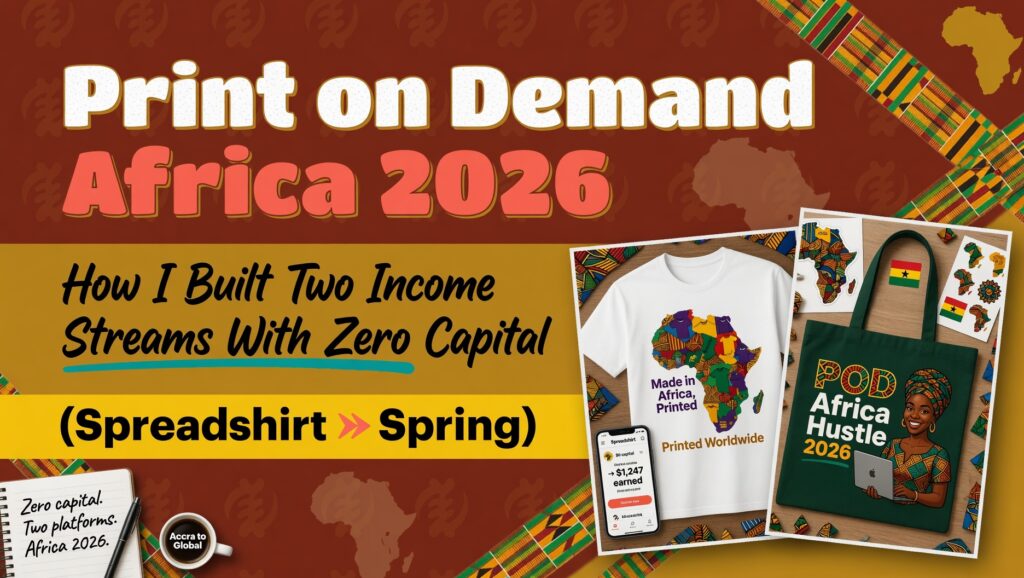
This post documents my real print on demand setup on TheDiaHub.com. Some links are affiliate links. All results, strategies, and platform details are honest and verified.
Let me tell you something most “make money online” posts will never tell you.
When TheDiaHub had 55 unique visitors, I did not wait for the traffic to grow before building income streams. I built the income infrastructure while the traffic was small — so that when it grew, the system was already running.
This is the story of how I built two separate print on demand income streams from Accra, Ghana, with zero upfront capital using two platforms you may have heard of but probably have not used together strategically: Spreadshirt and Spring (formerly Teespring).
One platform hunts for buyers I have never met across the global internet. The other converts the readers already sitting on my website into customers. Together, they form a multi-channel asset portfolio that earns whether I am publishing new content or not.
This is not theory. These are live products you can find on TheDiaHub right now. And by the end of this article, you will know exactly how to replicate this strategy from anywhere in Africa.
Table of Contents
- Why Print on Demand Is One of the Best Zero-Capital Businesses for African Creators
- The Two-Engine Strategy: How Spreadshirt and Spring Serve Different Purposes
- Phase 1: The Global Marketplace Engine — Spreadshirt
- Phase 2: The Audience Monetization Engine — Spring
- How I Create Professional Designs Using Free and Low-Cost AI Tools
- Getting Paid: How the Money Reaches Africa
- Honest Numbers: What to Realistically Expect
- The Verdict: Why You Need Both Platforms, Not Just One
- Step-by-Step Setup Guide: Start Today From Your Phone
- What Sells: Niche and Design Strategy for African Creators
- Common Mistakes to Avoid
- Phase 3: The Intelligence Engine — Amaze Moments AI (Coming Soon)
- Frequently Asked Questions
- Sources and References
Why Print on Demand Is One of the Best Zero-Capital Businesses for African Creators
Before diving into the specific strategy, let us establish why print on demand in Africa in 2026 makes sense as a starting point for a creator with limited resources.
Print on demand means you upload a design to a platform. When a customer anywhere in the world orders a product featuring your design — a T-shirt, a hoodie, a phone case — the platform prints it, ships it, handles customer service, and pays you a royalty or profit. You never touch inventory. You never pay for products that do not sell. You never run out of stock.
It is 100% free to use. You will only ever be charged for a product when someone purchases an item from you. The platform charges a base cost for each item and leaves you to put your profit on top — you keep 100% of whatever you decide to sell the product for above the base cost.
This is the model that makes print on demand uniquely suited to African creators:
Zero financial risk. You do not buy stock upfront. If a design does not sell, you lose nothing except the time it took to create and upload it. For a creator in Accra or Lagos working with limited capital, this removes the single biggest barrier to starting a product business.
Zero inventory. No storage. No shipping. No customs declarations. No logistics headache. The entire fulfilment chain — printing, packaging, shipping, tracking, returns — is handled by the platform.
Global distribution from day one. Your design can be bought by someone in London, Toronto, Houston, or Johannesburg the same day you upload it. The platform’s infrastructure serves customers worldwide. You access that infrastructure for free.
Passive earning potential. A design uploaded today can earn royalties three years from now without any additional work. Unlike freelancing — where your income stops when you stop working — print on demand creates assets that generate income independently.
Cultural content has real global demand. From couture to conscious fashion, Nigerian and broader African brands are redefining style, sustainability, and cultural storytelling — and 2026 is theirs for the taking. As the industry continues to grow, more Africans — including those in the diaspora — are becoming intentional about supporting homegrown brands rooted in their culture, environment, and lived experiences. This diaspora demand is your built-in global market.
The Two-Engine Strategy: How Spreadshirt and Spring Serve Different Purposes
The critical insight that most print-on-demand guides miss is that different platforms serve fundamentally different traffic sources. Using only one platform means you are either hunting for new buyers without capturing existing readers, or capturing existing readers without reaching new buyers.
The two-engine strategy solves this:
Engine 1: Spreadshirt → hunts for strangers using its marketplace traffic Engine 2: Spring → converts readers already on your website
Think of it this way. Spreadshirt is a department store where millions of buyers browse daily. By placing your designs on the Spreadshirt marketplace, you are renting shelf space in that store for free. When a stranger searches for “Ghana Pride hoodie” or “Sankofa Bird T-shirt,” your product has a chance to appear in their results.
Spring is different. It has no meaningful public marketplace. It is a fulfilment engine — a backstage operation that handles printing and shipping while you control the front stage. You bring your own audience and convert them into buyers using your own website, social media, and email list.
Using only Spreadshirt means you depend entirely on marketplace discovery and compete against thousands of other designs for visibility.
Using only Spring means you depend entirely on your own traffic, which at 55 visitors per day produces limited volume.
Using both simultaneously means you are always working two channels at once — one passive and marketplace-driven, one active and audience-driven. This is how you transition from a basic informational blog to an authoritative, cash-flowing digital entity.
Phase 1: The Global Marketplace Engine — Spreadshirt
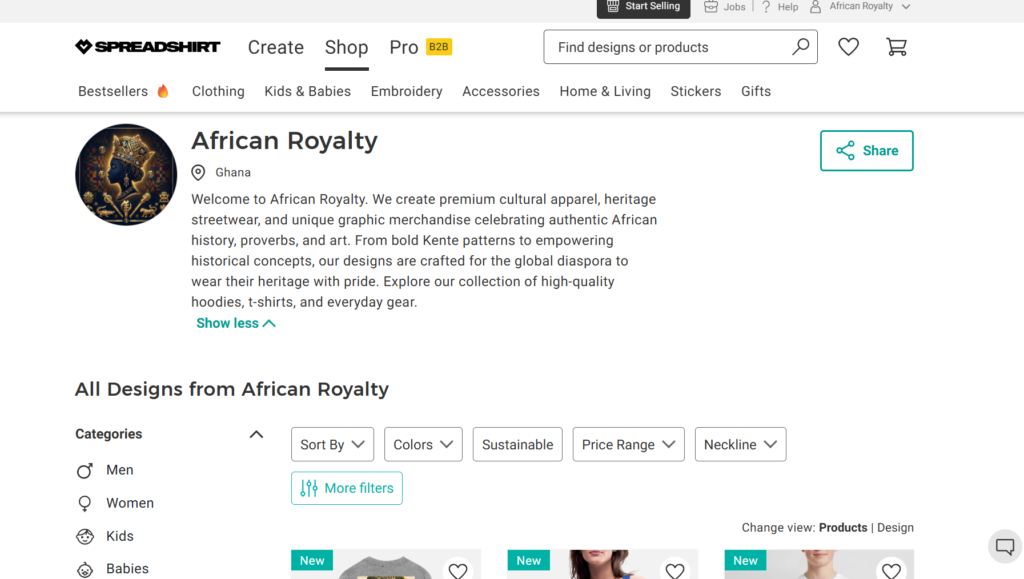
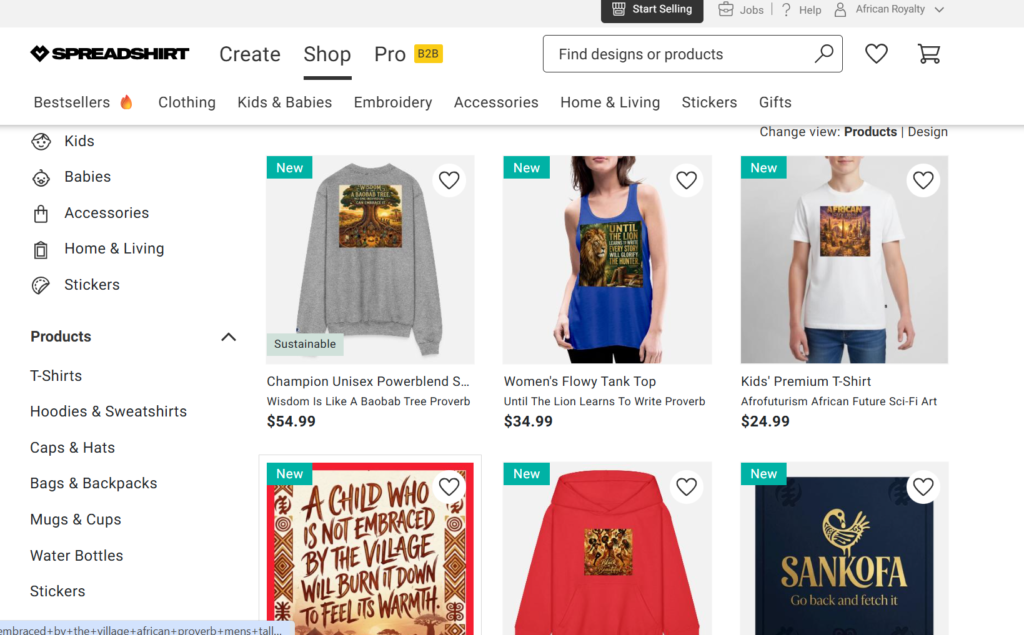
check out Africa Royalty shop here
What Spreadshirt Is and Why It Works for African Creators
Spreadshirt is one of the world’s largest print on demand marketplaces, with millions of active international buyers browsing their catalogue daily. Spreadshirt’s marketplace actively hosts African American and Africa themed designs, with dedicated category pages for African design, African American, and Africa T-shirts all receiving organic search traffic from global buyers.
This is the marketplace engine of the strategy. When you upload a design to Spreadshirt’s marketplace, you are not just creating a product you are creating an indexed asset that Spreadshirt’s internal search engine, Google, and other search engines can find and serve to buyers organically.
The strategy here is pure search engine optimisation applied to a marketplace. Spreadshirt has millions of active international buyers browsing their catalogue daily for cultural heritage, diaspora pride, and custom gifts. By uploading high-contrast, professional designs with precise keyword tags, your products index instantly in global search results.
My African Royalty Collection on Spreadshirt
For TheDiaHub, I launched the African Royalty collection directly on the Spreadshirt Marketplace. The collection draws from pan-African identity, Ghana’s cultural symbols, and the global African diaspora’s pride in heritage.
Designs in this collection include:
- Black Pharaoh — High-contrast ancient Egyptian aesthetic celebrating African kingship and ancestral excellence
- Sankofa Bird — The Akan symbol of learning from the past while building the future, rendered in bold graphic style
These are not random designs. They target specific identity groups with genuine purchasing intent:
- The African diaspora in the United States (40+ million people actively buying cultural apparel)
- UK, Canada, and Caribbean Afro-communities celebrating heritage
- Juneteenth and Black History Month shoppers — high-purchase-intent seasonal buyers
- Pan-African movement supporters globally
The SEO Tagging Strategy That Gets Your Products Found
The difference between a Spreadshirt design that sits unnoticed and one that earns consistent royalties is almost entirely in the keyword tags. Trending print-on-demand designs in 2026 are centered around niche identity shirts, cultural heritage, and nostalgic aesthetics — and the winning strategy is writing SEO-aware titles, tags, and descriptions around the exact phrasing buyers actually use.
For African cultural designs, the highest-performing keyword categories are:
Diaspora identity tags: #GhanaPride #NigerianPride #AfricanAmerican #BlackExcellence #Juneteenth #BlackHistory #PanAfrican #AfricanHeritage
Cultural symbol tags: #Sankofa #Adinkra #Kente #BlackPharaoh #AfricanRoyalty #AncestralPride
Occasion tags (seasonal buying spikes): #JuneteenthGift #BlackHistoryMonth #AfricanPrideTShirt #HBCUApparel #DasporaGift
Practical tagging rules:
- Use all available tag slots — do not leave any empty
- Mix broad tags (
#AfricanAmerican) with specific tags (#GhanaPride) to capture both high-volume and high-intent searches - Include gift occasion tags — buyers searching for gifts have high purchase intent and convert better than general browsers
- Update your tags seasonally — add
#Juneteenthtags in May for June sales,#BlackHistoryMonthtags in January for February sales
The Spreadshirt Financial Model
Spreadshirt operates on a royalty model. You set a royalty percentage above the base product cost. Spreadshirt handles the production and charges the customer the total price (base cost + your royalty).
Example on a T-shirt:
- Spreadshirt base cost: ~$14
- Your royalty: $6–$10 (approximately 30–40% above base)
- Customer price: $20–$24
- You receive: $6–$10 per sale
Important Spreadshirt payment note: To receive your Spreadshirt payouts, you add your payment details under Account → Payment Data. There are two payment options: direct deposit to a US bank account or a PayPal transfer. Direct deposit only allows transfers in US dollars.
For African creators, the PayPal route is the most accessible. PayPal is available in Ghana, Nigeria, Kenya, and most African markets. Alternatively, if you have a Payoneer US virtual bank account (the routing number and account number Payoneer provides), you can use Spreadshirt’s direct deposit option and receive USD directly into your Payoneer account.
The Spreadshirt advantage in one sentence: It costs $0 upfront, Spreadshirt handles printing, customer service, and global shipping, and every time a stranger buys your design, you collect a royalty payout straight to your PayPal or Payoneer wallet.
Phase 2: The Audience Monetization Engine — Spring

Visit shop
What Spring Is and Why It Is Different From Spreadshirt
Spring lets you set whatever retail price you want above their base cost. If a hoodie costs Spring $25 to produce, you can sell it for $45, $55, or $75. Your profit is the difference. Spring does not have a public marketplace to give you free traffic — it acts as a private fulfilment engine.
This is the key distinction. Spring is not where you go to find new buyers. It is where you go to serve the buyers you already have — your blog readers, your email subscribers, your social media followers, your WhatsApp community.
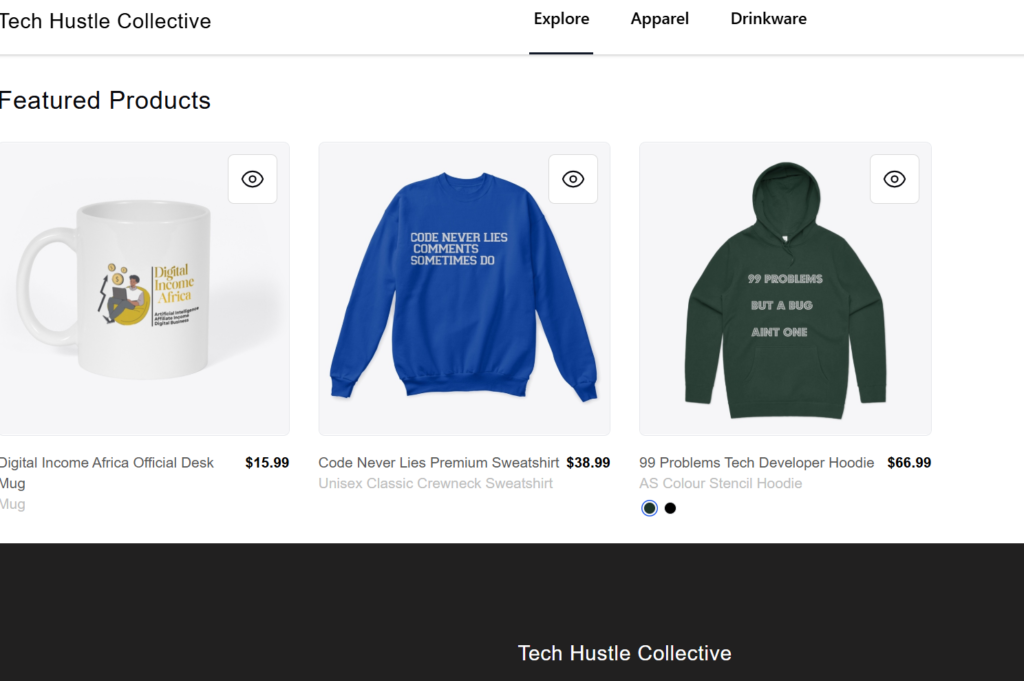
For TheDiaHub, I launched The Tech Hustle Collective using Spring. This is a dedicated apparel line engineered specifically for the software engineers, freelancers, and digital builders who read this blog.
The Tech Hustle Collective
The concept behind The Tech Hustle Collective is hyper-targeting. These are not generic designs trying to appeal to everyone. They speak directly to a specific tribe: people who build things with technology, who understand the frustration and pride of the digital creator journey, and who wear their identity as builders proudly.
The flagship product: The “99 Problems But A Bug Ain’t One” premium hoodie — a cultural reference that every developer, freelancer, and tech entrepreneur immediately recognises and connects with. It signals membership in the builder community before the wearer says a word.
The creators making serious money from print-on-demand apparel use lifestyle photography and emotional connection to sell a feeling, not just a physical item. When you show your hoodie on someone in a home office with multiple monitors, a coffee cup, and a look of focused concentration, you are selling the entire experience of being a productive digital creator — not just a piece of clothing.
For the Tech Hustle Collective mockups, I used Arena AI to generate cinematic lifestyle mockups — AI-generated product photography that looks like high-end corporate ad campaigns without hiring a model or renting a studio. The result is professional product imagery that matches the quality of brands spending thousands on photography.
The WordPress Integration Strategy
This is the element that separates Spring from a simple online shop. Using WordPress Spectra blocks, the Tech Hustle Collective products are embedded natively into TheDiaHub’s global infrastructure:
In the sidebar: Every article page on TheDiaHub shows a clickable mockup of the hoodie in the sidebar. A reader who arrives to learn about SEO, freelancing, or digital income sees the product without being redirected anywhere. The purchase opportunity comes to them.
In the navigation menu: The main navigation menu includes a “Shop” link leading to the full Spring storefront. For readers who explore beyond the article they landed on, the shop is one click away from anywhere on the site.
Why this integration matters: Most blogger merchandise strategies fail because the shop lives on a separate platform and requires the reader to actively choose to go there. By embedding the products into the site’s permanent structure — sidebar and navigation — every page view becomes a passive product impression. The reader does not need to seek out the shop. The shop finds the reader.
The Spring Profit Model
Spring charges a base cost for each item and leaves you to put your profit on top. You keep 100% of whatever you decide to sell the product for above the base cost.
Hoodie profit example:
- Spring base cost for a premium hoodie: approximately $27–$30
- Your retail price: $48–$52
- Your profit per sale: approximately $18–$25
For TheDiaHub’s Tech Hustle Collective hoodie priced to generate $21 in pure profit, you need:
- 5 hoodie sales per month = $105/month passive income
- 10 hoodie sales per month = $210/month passive income
- 48 hoodie sales per month = $1,008/month
To make $1,000 a month from hoodies, you only need to sell approximately 50 units. You are doing less than a third of the customer service work compared to selling cheaper items, managing fewer orders, dealing with less potential for lost packages — all while making the same amount of money. This is why focusing on dollars earned per transaction, not just the number of transactions, is critical.
Spring payout: Spring pays via PayPal or Payoneer. Minimum payout threshold applies — verify current threshold at Spring’s platform settings before starting.
How I Create Professional Designs Using Free and Low-Cost AI Tools
The quality of your designs determines whether your products get clicks. Amateur designs get ignored. Professional designs get bought. Here is the exact toolkit I use to create both:
Arena AI (Free – For Cinematic Mockups)
Arena AI generates cinematic lifestyle mockups from text prompts. You describe the scene — “Black male entrepreneur in a modern home office wearing a dark hoodie, dual monitors in background, natural window light, professional photography style” — and Arena AI generates photorealistic imagery. This is the tool behind the Tech Hustle Collective product photography.
For sellers who want product mockups that look like a $5,000 photography session at a fraction of the cost, Arena AI is the tool. It turns a plain design into a story.
Canva (Free — For Design Creation)
Notion templates can be purchased from creators on platforms like Etsy, Gumroad, and Notion’s own Template Gallery — and Canva is the tool most creators use to build the visual assets behind those templates and print-on-demand designs.
Canva’s free plan provides everything needed to create professional T-shirt and hoodie designs:
- 250,000+ templates including apparel design templates
- Text effects for bold typographic designs
- Illustration and icon libraries
- Transparent background export (required for print-on-demand uploads)
For text-based designs like “99 Problems But A Bug Ain’t One,” Canva handles the full design process from concept to print-ready file.
CapCut (Free — For Product Promo Videos)
A 15-second product promo video on TikTok or Instagram Reels showing your hoodie mockup with a caption like “Built for builders ” can drive more traffic to your Spring store than a written post. CapCut handles the video creation entirely on your phone.
The Design Rules That Determine What Sells
The winning strategy for print-on-demand in 2026 involves writing SEO-aware titles, tags, and descriptions around the exact phrasing buyers use — and building around niches that have repeat language and built-in gift occasions.
Rule 1: High contrast always outperforms low contrast. Dark design on light garment or light design on dark garment. Avoid designs that blend into the fabric colour. Your design must be clearly visible in a thumbnail at 200×200 pixels — the size at which most marketplace buyers first see your product.
Rule 2: Specific identity beats generic aspiration. “African Royalty” outperforms “Strong and Beautiful.” “99 Problems But A Bug Ain’t One” outperforms “Coder Life.” The more specifically your design speaks to a defined identity group, the more that group feels seen — and buys.
Rule 3: Test text before testing illustrations. Typographic designs (bold text with strong font choices) are faster to produce, cheaper to print (single colour = lower base cost), and often outperform illustrated designs in cultural apparel niches. Start with text concepts. Add illustration after you have validated a concept sells.
Rule 4: Seasonal timing multiplies sales. Juneteenth (June 19), Black History Month (February), African Liberation Day (May 25), and Pan-African Flag Day (August 17) are all occasions when diaspora apparel searches spike significantly. Upload themed designs 4–6 weeks before each occasion to give Spreadshirt’s algorithm time to index them before peak demand.
Getting Paid: How the Money Reaches Africa
This is the section that most print-on-demand guides skip — and it is the most practically important part for African creators.
The Payment Flow
SALE MADE (anywhere in the world)
         ↓
PLATFORM PROCESSES PAYMENT (Spring or Spreadshirt)
         ↓
YOUR PROFIT CREDITED TO PLATFORM WALLET
         ↓
WITHDRAWAL VIA PAYPAL OR PAYONEER
         ↓
GHANA BANK → MTN MOMO / TELECEL CASH
Payoneer for Print on Demand Payments
Payoneer connects with more than 2,000 marketplaces, platforms, and networks. For Nigerian freelancers and creators specifically, keeping earnings in USD is essentially a survival strategy — the currency is more stable, and Payoneer makes this possible by letting you get paid in USD and hold it until you need to convert to local currency.
For print-on-demand specifically, Payoneer gives you:
- A US virtual bank account (routing number + account number) for platforms that pay by bank transfer
- PayPal-equivalent accessibility for platforms that pay via PayPal to linked accounts
- Withdrawal to your Ghana, Nigeria, or Kenya bank account in local currency
- The ability to keep earnings in USD and convert only when needed — protecting your income from currency volatility
The E-Levy is gone. Since April 2025, the 1% Electronic Transfer Levy no longer applies to mobile money transactions in Ghana. Your bank-to-MoMo transfers are cheaper than they were in 2023 and 2024.
Minimum Payout Thresholds
Both Spring and Spreadshirt have minimum payout thresholds before they release your earnings. Verify the current thresholds directly on each platform before setting up, as they update periodically. The practical implication: in your first month with low sales volume, your earnings may sit in your platform wallet below the payout threshold. This is normal. As sales accumulate, they release on schedule.
Honest Numbers: What to Realistically Expect
Print-on-demand is not a get-rich-quick strategy. It is a long-tail asset-building strategy. Here is what realistic expectations look like at different stages:
Month 1–3: Building the Asset Base
- Activity: Upload 15–20 designs across both platforms, optimise tags and descriptions, embed Spring products into your WordPress site
- Expected sales: 0–5 total sales across both platforms
- Expected income: $0–$50
- What this stage is actually doing: Building indexed assets that compound over time. A design uploaded in month 1 can still be generating its first sales in month 8.
Month 3–6: Early Traction
- Activity: Analyse which designs got impressions on Spreadshirt (check your dashboard), add seasonal designs, share Spring products in TikTok and WhatsApp communities
- Expected sales: 5–20 sales per month across both platforms
- Expected income: $50–$300/month
- The compound effect begins: Designs with early sales get ranked higher in Spreadshirt’s internal search. Higher-ranked designs get more organic visibility. More visibility creates more sales.
Month 6–12: Consistent Passive Income
- Activity: Primarily uploading new designs monthly, analysing sales data, adding seasonal content. Passive management of existing asset base.
- Expected sales: 20–60 sales per month (combined)
- Expected income: $200–$1,200/month at $10–$21 average profit per sale
- The strategic milestone: At this stage, your print-on-demand income runs largely without active effort. You are earning while publishing new blog content, while sleeping, while working on other income streams.
The sellers making serious money in 2026 are not choosing between one platform or another — they use multiple channels simultaneously. Redbubble and Spring are supplementary income channels, not primary business platforms, and the creators who treat them as one layer in a diversified income stack earn consistently even when individual platforms fluctuate.
The Verdict: Why You Need Both Platforms, Not Just One
If your blog traffic is sitting at 55 unique visitors, relying on a single stream of income will stall your growth. True digital stability requires a diversified approach.
The Spreadshirt Marketplace actively hunts for global traffic using Spreadshirt’s search volume and SEO reach. It earns from strangers who will never visit TheDiaHub — buyers in Houston searching for Black Pharaoh designs, buyers in London looking for Sankofa gifts, buyers in Toronto celebrating Juneteenth.
Spring maximises the value of the traffic already standing on your website. A reader who has just finished reading a guide on building digital income from Africa and sees a “99 Problems But A Bug Ain’t One” hoodie in the sidebar is primed to buy. They trust you. They identify with your content. The product is an extension of that identity.
One platform reaches the world. The other deepens the relationship with your community. Together, they cover the full spectrum of your potential buyers — the strangers and the loyal readers.
This is not just a print-on-demand strategy. This is the architecture of a multi-channel digital asset portfolio built from zero capital.
Step by Step Setup Guide: Start Today From Your Phone
Setting Up Spreadshirt (30 minutes)
- Go to spreadshirt.com and click “Sell Your Designs”
- Create a free account — no credit card required
- Set up your seller profile with a name for your shop (e.g., “African Royalty by TheDiaHub”)
- Click “Upload Design” and add your first design file (PNG with transparent background, minimum 2000×2000px, 150 DPI)
- Select which products to apply your design to — start with T-shirts and hoodies, the highest-selling categories
- Write your product title with your primary keyword at the beginning: “Ghana Pride Sankofa Bird T-Shirt — African Heritage Apparel”
- Add all available tags using the keyword strategy above
- Write a description that addresses the buyer’s identity and the product’s cultural significance
- Set your royalty margin (15–30% above base is competitive without pricing yourself out)
- Go to Account → Payment Data and add your PayPal or Payoneer US bank details
- Publish — your design is now live on Spreadshirt’s global marketplace
Setting Up Spring (45 minutes)
- Go to spri.ng and create a free account
- Set up your store with a name that reflects your blog brand: “The Tech Hustle Collective”
- Click “Create” and choose your product (hoodie recommended for highest profit per sale)
- Upload your design file (same specs as Spreadshirt)
- Set your retail price — aim for at least $20 above the base cost shown for meaningful profit margin
- Use Arena AI or Canva to create your product mockup images
- Write your product title and description to speak directly to your audience’s identity
- Go to “Payouts” in your account settings and connect PayPal or Payoneer
- In WordPress, install the WP Spectra or Elementor page builder (both have free plans)
- Copy your Spring product page URL
- Create a clickable image block in your sidebar linking to your Spring product with the product mockup as the image
- Add a “Shop” link to your WordPress navigation menu pointing to your full Spring storefront
- Publish — your product is now embedded in your site’s permanent structure
What Sells: Niche and Design Strategy for African Creators
Based on current marketplace data and cultural consumer trends in 2026, these are the highest-potential design niches for African creators:
Tier 1: Highest Global Demand
African Diaspora Identity Designs celebrating pan-African heritage, Ghanaian/Nigerian/Kenyan cultural pride, and diaspora identity consistently rank among the top-selling categories in African and African American apparel on Spreadshirt. The global African diaspora — estimated at over 200 million people across the Americas, Europe, and the Caribbean — actively buys cultural apparel year-round.
Keywords to target: Ghana Pride, Nigerian King/Queen, African Royalty, Melanin Excellence, Diaspora Proud, Black Excellence, Adinkra symbols, Kente-inspired
Tech and Digital Creator Identity The intersection of African identity and technology — the African developer, the Lagos startup founder, the Nairobi app builder, the Accra digital entrepreneur — is an underserved niche with high purchase intent. Your TheDiaHub audience IS this niche.
Keywords to target: African Developer, Tech Hustle, Code Africa, Silicon Savanna, Lagos Tech, African Engineer, Nairobi Startup
Tier 2: Strong Seasonal Demand
Juneteenth (June) — Major annual buying occasion for African American cultural apparel. Upload designs 4–6 weeks before June 19.
Black History Month (February) — Both US and UK markets. Historical figures, liberation movements, educational pride.
African Liberation Day (May 25) — Pan-African political pride. Flags, continent silhouettes, liberation iconography.
Kwanzaa (December) — Cultural celebration apparel for the African American community.
Tier 3: Evergreen Gifting Niches
Graduation gifts, mother’s day and father’s day designs with cultural-specific messaging (“Best Ghanaian Dad” / “Nigerian Queen”), and profession-specific designs for African professionals (doctors, engineers, teachers, nurses) all perform consistently year-round because they have built-in gifting occasions.
Common Mistakes to Avoid
Mistake 1: Uploading generic designs that speak to no one A black T-shirt that says “Africa” will compete with thousands of identical designs and convert nobody. A design that says “Sankofa — I Know Where I Came From” speaks to a specific cultural understanding and emotional truth. Specificity converts. Generality does not.
Mistake 2: Ignoring the tag and keyword fields Your design cannot sell if it cannot be found. Every empty tag slot is a missed discovery opportunity. Spend as much time on your keyword strategy as on your design itself.
Mistake 3: Pricing too low on Spring Consumers are conditioned by retail stores to accept that outerwear costs significantly more than base layers. When a shopper lands on your listing, they are not comparing your $48 price tag to the $27 production cost they cannot see. A hoodie is seen as a substantial piece of clothing — a statement piece, often viewed as a thoughtful gift. Charge accordingly. Underpricing signals low quality, not value.
Mistake 4: Not embedding Spring products into your website structure A standalone Spring storefront that only receives traffic when you actively promote it will never reach its potential. Embedding your products into the permanent sidebar and navigation menu of your WordPress site turns every page view into a passive product impression — without any additional promotion effort.
Mistake 5: Expecting fast results and quitting before the compound effect begins Print-on-demand income compounds over time as your indexed designs accumulate sales history and marketplace ranking. Sellers who upload 20 designs, see minimal sales in month 1, and abandon the strategy never reach the inflection point where their asset base starts generating consistent passive income. Commit to at least 90 days before evaluating whether the strategy is working.
Mistake 6: Not linking designs to cultural occasions A generic African heritage design earns year-round at a low baseline. The same design tagged for Juneteenth and uploaded 5 weeks before June 19 earns 5–10× its baseline during the Juneteenth buying season. Seasonal alignment is free leverage that most sellers ignore.
Frequently Asked Questions
Do I need to pay anything to start on Spreadshirt or Spring?
No. Spreadshop (Spreadshirt’s partner shop) is 100% free — no surprise fees, no subscription charges, no catch. You can only make money, never lose it. There is absolutely no risk or obligation involved. Spring operates on the same model — free to join, you only earn a charge when a product is sold. Both platforms are zero upfront cost.
Can I use both platforms with the same designs?
Yes. You can upload the same design to both Spreadshirt and Spring simultaneously. Spreadshirt reaches its marketplace audience and Spring serves your website audience with the same design. There is no exclusivity requirement on either platform.
How do African diaspora buyers in the US find my Spreadshirt designs?
Through Spreadshirt’s internal search engine, Google Shopping, and general web search. When a buyer in Houston searches “Sankofa Bird hoodie” on Google, products indexed on Spreadshirt’s marketplace can appear in results. This is why keyword tagging is critical — your design is only discoverable for the keywords you have tagged it with.
What file format do I need for my designs?
PNG with a transparent background. Minimum 2000×2000 pixels at 150 DPI for standard print. Both Canva (free) and Photopea (free, browser-based Photoshop alternative) can export PNG files with transparent backgrounds. Canva’s free plan specifically supports transparent background export.
How long before I see my first sale?
It varies. Designs in high-demand niches with strong keyword tagging can get first sales within days of upload. Designs in lower-demand niches may take weeks or months to earn their first sale. The consistent variable is: the more designs you upload, the more chances you have for a sale. 20 designs have 4× more chances than 5 designs. Build your library consistently.
Can I do this entirely from a smartphone?
Yes. Canva mobile handles design creation. Spreadshirt and Spring both have mobile-accessible interfaces for uploading and managing products. WordPress mobile allows embedding Spring product links into your sidebar. The only task that benefits from a laptop is detailed mockup work using Arena AI’s web interface — which is manageable on a phone but more precise on a larger screen.
What happens if a customer complains or wants a refund?
Both platforms handle customer service and returns directly. You are not involved in dispute resolution, refund processing, or replacement shipments. The platforms manage the full post-sale experience. Your responsibility ends at creating and uploading the design.
Phase 3: The Intelligence Engine — Amaze Moments AI (Coming Soon)
Here is something important you need to know before I close this article.
Spring is not just a standalone print on demand platform. It is owned by Amaze a company that has been quietly building what they call “a new operating system for creator commerce.” And what they are about to release changes the game for African content creators specifically.
What Amaze Is Building
Amaze describes their new product as Moments AI — an AI-powered capability that transforms your most engaging content into products. The concept is built around four steps: you post content, they identify the moments your audience is reacting to most, those moments become product ideas and designs, and you launch while your audience is still engaged and talking about it.
Read that again carefully. Right now, the two-engine strategy I described in this article requires you to:
- Manually decide what designs to create
- Manually build those designs in Canva
- Manually upload to Spring and Spreadshirt
- Hope the design resonates with your audience
Amaze Moments AI removes all of that manual guesswork. Their system watches your content across TikTok, Instagram, YouTube, and other platforms. When a post spikes — when the comments roll in and your audience tells you with their engagement what they love — Amaze’s AI converts that signal directly into a product.
The idea is that every moment is a product waiting to happen. When a post spikes and comments roll in, your audience is already telling you what they want. Moments AI turns that signal into a product automatically.
For a TheDiaHub article about building digital income from Ghana that gets unexpected shares and comments , Amaze would identify that moment, generate a design concept from it (“Digital Income Africa on a premium hoodie, for example), and give you the option to launch it while the engagement is still live.
This solves the single biggest friction point in the two-platform strategy: timing. The window between a viral moment and peak buying intent is often 24–72 hours. Manually building and uploading a design takes hours you may not have. Amaze automates the entire conversion from moment to merch.
Why This Matters for African Creators
The current print on demand model rewards patience — you build a library of designs and wait for the SEO to compound. Amaze Moments AI rewards cultural velocity — the speed at which African creators respond to what is happening in their community right now.
An African creator whose content resonates with the diaspora , a Ghana independence day post, a Nairobi startup culture video, a comment thread about African tech can now convert that viral moment into a product available for purchase within hours, not days.
This is not guessing what will sell. This is letting your audience’s behaviour tell you, in real time, what they want to buy.
The $20,000 Waitlist Challenge
Amaze is currently accepting waitlist signups ahead of the Moments AI launch. They are running a referral challenge with a $20,000 prize pool for creators who refer others to join the waitlist.
Selected creators who opt in for beta testing will get early access to the new capability, custom merch designs based on their content, and a $20 gift card for participating.
Since Spring (which powers Phase 2 of this strategy) is owned by Amaze, joining the waitlist is the natural next step for any creator already using or planning to use Spring. You will be among the first to access Moments AI when it launches — meaning you can activate the intelligence layer on top of the two-engine strategy already running.
Join the Amaze Moments AI Waitlist →
When you join through this link, you enter the referral challenge automatically. Fill in your social handle, follower count, and your biggest challenge as a creator. If selected for beta testing, Amaze will contact you directly with early access.
How Amaze Fits Into the Full Strategy
Think of the three phases as a progression:
| Phase | Platform | Role | Status |
|---|---|---|---|
| Phase 1 | Spreadshirt | Hunt global buyers with SEO | Active — start today |
| Phase 2 | Spring | Convert your existing audience | Active — start today |
| Phase 3 | Amaze Moments AI | Turn viral content into instant merch | Coming soon — join waitlist |
Phases 1 and 2 are your foundation. Phase 3 is the intelligence layer that makes the whole system respond to culture in real time. Build the foundation now. The intelligence layer will be ready when you are.
Your Next Steps: Start Building Your Print on Demand Asset Base Today
The strategy is complete. Two platforms. Two traffic sources. One unified brand identity. Zero financial risk.
Here is your immediate action plan:
- Create your first design today — Open Canva on your phone. Create a bold text-based design targeting one of the Tier 1 niches above. Export as PNG with transparent background.
- Upload to Spreadshirt first — Set up your free seller account, configure payment to PayPal or Payoneer, and publish your design with full keyword tagging.
- Set up your Spring store — Create your Tech Hustle Collective or equivalent brand. Upload the same design, set a competitive price, configure Payoneer payout.
- Embed Spring into your WordPress site — Add a clickable product mockup to your sidebar. Add “Shop” to your navigation menu.
- Commit to 90 days — Upload at least 2 new designs per week for 12 weeks. By the end of 90 days, you will have 24+ indexed designs across both platforms. That is when the compound effect begins to show.
- Join the Amaze Moments AI waitlist — Since Spring is owned by Amaze, get early access to the AI layer that turns your viral content moments into instant merch. Join free here →
The readers of TheDiaHub already trust the content. Some of them will become customers of the products. Some of those customers will share the products. And some of those shares will bring new readers who become new customers.
This is how a blog with 55 daily visitors builds something real while it grows.
Written by Latif Saeed Okwan — digital entrepreneur from Accra, Ghana, building and documenting real income streams from West Africa. The Spreadshirt African Royalty collection and Spring Tech Hustle Collective are live products on TheDiaHub.com, created using the exact strategy described in this article.
Sources and References
- Spring (Teespring) Free Model Confirmed — storehacks.com/teespring-reviews/ (2024)
- Spring vs Redbubble 2026 — merchtitans.com/blog/redbubble-vs-teespring-comparison (April 2026)
- Teespring Profit Calculator — topbubbleindex.com/blog/teespring-profit-calculator (October 2025)
- POD Hoodies Profit Guide 2026 — listybox.com/blog/print-on-demand-hoodies-etsy-profit-guide-2026 (March 2026)
- Spreadshirt African American T-Shirts Marketplace — spreadshirt.com/shop/clothing/t-shirts/african-american/ (2026)
- Spreadshirt Africa Category — spreadshirt.com/shop/clothing/t-shirts/africa/ (2026)
- Spreadshirt Payment Options — famuse.co/get-my-money-from-spreadshirt/
- Trending T-Shirt Designs 2026 — mydesigns.io/blog/trending-t-shirt-designs-2026/ (April 2026)
- Nigerian Fashion Brands 2026 — marieclaire.ng/fashion-brands-to-watch-in-2026/ (January 2026)
- Payoneer Nigeria Market — grabrfi.com/en/blog/what-is-payoneer (December 2025)
- Payoneer Marketplace Payouts — payoneer.com/marketplace/get-paid-by-marketplaces/ (2025)
- E-Levy Abolition Ghana April 2025 — momocalc.com/ghana (April 2026)
- Amaze Commerce — Moments AI Waitlist — amaze.co/amazecommercewaitlist (2026)
- Spring by Amaze — Official Platform — amaze.co/spring (2026)
Related Articles on TheDiaHub.com:
- Can You Really Run an Online Business With Only a Smartphone in 2026? (Honest Truth)
- AI Tools Recurring Commission 2026: 8 Best Programs Paying Monthly
- Best Platform to Sell Digital Products in Africa 2026: Selar vs Systeme.io vs GoHighLevel vs Shopify

Latif Saeed Okwan is a digital entrepreneur from Accra, Ghana helping Africans build real online income through affiliate marketing, AI tools, and digital business. Every method on TheDiaHub.com has been personally researched with the African reality in mind — no hype.