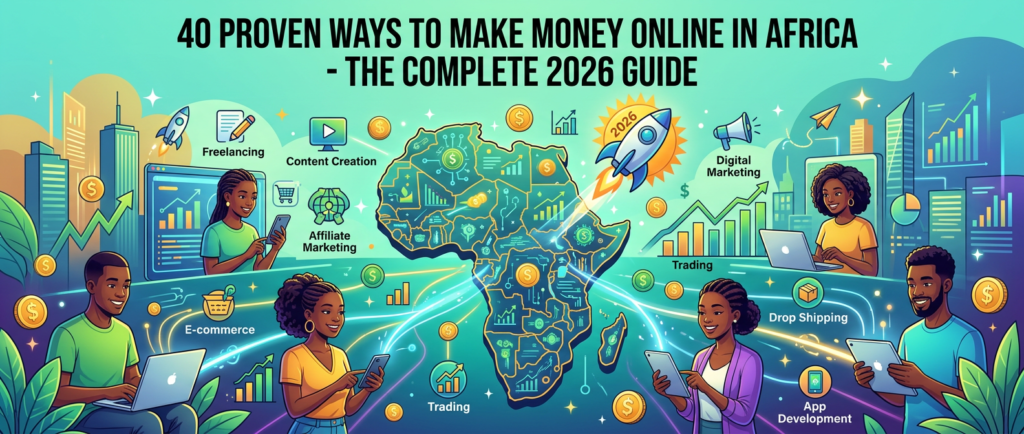
The internet has made geography irrelevant. Whether you are in Accra or Abuja, Nairobi or Cape Town, the same digital economy that is minting millionaires in Silicon Valley is wide open to you right now. US e-commerce sales alone have crossed $1.65 trillion — and that number is expected to nearly double by 2030. Social commerce globally is projected to hit $6.2 trillion by the same year.
You do not need to be based in America to capture a slice of that.
What you need is clarity on which income models actually work, which platforms pay Africans reliably, and how to sequence your efforts so you are generating real income before your motivation runs out.
This is that guide. Forty legitimate, proven income streams organised by category, explained practically, and written specifically for African creators and entrepreneurs building from the ground up.
A Quick Word Before We Start
Not every method on this list will suit you equally. Some are immediate you can earn within days. Some are long-term investments that pay off in months. The smartest approach is to combine one fast income stream with one long-term asset-building stream and work both simultaneously.
Here is a realistic timeline to set your expectations:
Days to weeks: Freelancing, tutoring, virtual assistance, transcription. You are trading your time for money immediately.
Weeks to months: Affiliate marketing, digital product sales, social media monetisation. Once you have a small engaged audience or email list, income starts flowing.
3–9+ months: Blogging with SEO, YouTube ad revenue, print on demand brands, online courses. These are assets you are building. They take longer but they pay you while you sleep.
Build all three layers at once and you will have both stability and scale.
PART ONE: MAKE MONEY WITH CONTENT CREATION
Content is one of the most powerful income vehicles on the internet because the work you do once can pay you repeatedly. A blog post written today can drive affiliate commissions in 2028. A YouTube video uploaded this week can earn AdSense revenue for years. Every piece of content is a permanent asset.
1. Start a Blog
Blogging remains one of the most reliable long-term income streams available to African creators. You choose a niche you genuinely understand personal finance, entrepreneurship, African culture, parenting, travel, health and you consistently publish content that helps your readers solve real problems or make better decisions.
As your audience grows, you monetise through Google AdSense (display ads), affiliate links, sponsored posts, digital product sales, and eventually consulting or coaching. Most serious bloggers earn through multiple of these simultaneously.
The key insight most beginners miss: your blog post is not just an article. It is a product that ranks in Google search results and captures traffic passively for years. A single well-optimized blog post can bring in thousands of visitors every month from search and every one of those visitors is a potential buyer or subscriber.
Free platform: Blogger (by Google) — zero hosting cost, integrates with AdSense automatically. Graduate to a self-hosted WordPress site when income supports it.
Time to first income: 3–6 months with consistent publishing.
2. Start a YouTube Channel
YouTube is the second-largest search engine in the world and the most powerful long-term content platform for building an audience and income from Africa. Once your channel reaches 1,000 subscribers and 4,000 watch hours, you qualify for the YouTube Partner Programme — and from that point, every video you publish earns AdSense revenue automatically.
YouTube creators earn between $1.61 and $29.30 per 1,000 views depending on their niche, audience location, and advertiser demand. Finance, business, tech, and education channels consistently earn at the higher end.
Beyond AdSense, YouTube creators monetise through affiliate links in descriptions, sponsored brand deals, channel memberships, and selling their own digital products and courses. Many African creators are building channels around African entrepreneurship, finance, cooking, language, education, and lifestyle — categories that are underrepresented and heavily in demand.
Time to first income: 3–6 months to hit monetisation threshold with consistent uploads.
3. Start Vlogging
A vlog is a video diary — you document your life, your journey, your process, your experiences, and your perspective in short-form video. Successful vloggers on YouTube and Instagram build deeply loyal audiences because viewers feel a genuine personal connection with them.
The “building a business from Africa” angle is compelling content that does not yet have enough creators making it well. Your journey the real wins, the real obstacles, the specific context of building digital income from Ghana or Nigeria or Kenya is inherently interesting to a global audience that has never seen it from your perspective.
Monetise through ads, brand sponsorships, affiliate links, and merchandise. Average successful vlogs run 5–10 minutes.
4. Create Video Tutorials
If you have a teachable skill graphic design, video editing, coding, speaking a language, cooking a cuisine, running a specific software tool video tutorials are a direct path to income. Platforms like Udemy and Skillshare connect you to millions of learners actively searching for exactly what you know how to teach.
The global online learning market is projected to reach $75.52 billion by 2029. Every year, millions of people decide to learn a new skill online. Your expertise, packaged as a video course, serves that demand indefinitely.
Free tools to record and edit: Your smartphone camera + CapCut (free). No studio equipment required to start.
5. Start a Podcast
The global podcast market is projected to reach $130.63 billion by 2030. Audio content is booming because it fits into time that other content cannot — commutes, workouts, cooking, walking. A podcast with a focused niche and consistent publishing schedule can build a deeply engaged audience that sponsors genuinely want to reach.
Monetise through brand sponsorships, listener donations, premium content subscriptions, affiliate links, and live events. Anchor (now Spotify for Podcasters) is completely free to host and distribute your podcast to every major platform.
African podcast niches with strong demand: African business and entrepreneurship, continental politics and economics, African history and culture, pan-African diaspora stories, technology and innovation across Africa.
6. Publish an Ebook
The global ebook market is projected to reach $15.33 billion by 2027. You do not need a publisher, an agent, or a printing company. You write, format, and publish directly on platforms like Selar, Gumroad, or Amazon Kindle Direct Publishing and you start earning royalties immediately.
An ebook on a topic with genuine demand how to start a business in Ghana, how to pass a specific professional exam, how to cook authentic African dishes, how to manage money on a Nigerian salary can sell for $5–$20 and generate passive income for years.
Free production stack: Write in Google Docs. Design the cover in Canva. Export as PDF. Upload to Selar or Gumroad. Done.
7. Write Online Reviews
Platforms like UserTesting and Swagbucks pay you to test websites and apps or complete product reviews. This is not a significant income stream on its own, but it requires no skill, no setup, and pays immediately making it a useful starting point while you build more substantial streams in parallel.
PART TWO: GENERATE INCOME FROM ADVERTISING AND AFFILIATES
Once you have an audience even a small one you can earn from it passively through ads and affiliate commissions. These are some of the highest-margin income streams online because the product already exists and your job is purely to connect buyers with it.
8. Display Ads on Your Website or Blog
Once your blog or website generates consistent traffic, Google AdSense places relevant ads on your pages automatically and pays you every time a visitor views or clicks them. You do not manage the ads — Google does everything. You simply write the content that brings the traffic.
For African bloggers writing in English and targeting US, UK, or Canadian audiences, AdSense CPM (cost per thousand views) rates can be significantly higher than for locally-targeted content. A blog attracting 50,000 monthly visitors from high-CPM markets can earn $200–$500/month from AdSense alone before any affiliate income is added.
9. Affiliate Marketing
Affiliate marketing is the cornerstone of digital income for African entrepreneurs. You promote a product through a unique tracking link. When someone buys through your link, you earn a commission typically 20–75% of the sale price without ever handling the product, processing the payment, or managing a customer.
The best free affiliate platforms for African beginners:
ClickBank — the most accessible global affiliate network. High commissions (up to 75%), no application vetting for most offers, pays weekly via Payoneer. Focus on health, self-improvement, and digital product niches. Look for offers with a Gravity Score between 20 and 100.
Systeme.io — pays 60% recurring commission and uses a lifetime cookie, meaning your referrals are permanently attributed to you. One referral can pay you for years.
Selar — the best platform for promoting to African audiences. Payments go directly to your local bank account. Perfect for beginners in Ghana, Nigeria, or Kenya.
Amazon Associates — the most trusted affiliate brand globally. Lower commissions (1–10%) but extremely high conversion rates because everyone trusts Amazon.
10. Become a Social Media Influencer
Influencer marketing is now a mainstream marketing channel. Brands pay creators to authentically reach their audiences — and “authentic” is the operative word. A micro-influencer with 5,000 deeply engaged followers in a specific niche earns more per post than a generic account with 100,000 passive followers.
You do not need to be famous. You need to be trusted. Build a focused social media presence around a topic you genuinely know and care about, engage consistently with your followers, and the brand partnership opportunities come naturally as your credibility compounds.
African creators have a significant advantage in niches like African cuisine, fashion, travel, entrepreneurship, and culture areas where global audiences are actively hungry for authentic African voices.
PART THREE: GET PAID FROM FREELANCING AND SERVICES
Your existing skills are immediately worth money online. Someone in the US, UK, or Australia is willing to pay you right now for digital work you can do from your phone or laptop. Freelancing is the fastest path from zero to first online payment.
11. Freelancing
Freelancing lets you work on diverse projects, set your own rates, choose your own clients, and grow at your own pace. Almost every digital skill has a market: writing, design, video editing, coding, translation, social media management, virtual assistance, data entry, research, and dozens more.
Start here: Fiverr (clients come to you), Upwork (you apply to posted jobs). Both are free to join.
The skills earning the most right now: Video editing, AI prompt engineering and image editing, copywriting for tech and finance, social media management, and website development.
Getting your first reviews: Price your first three jobs slightly below market average. Deliver ahead of schedule. Communicate proactively. Five positive reviews change your visibility on these platforms completely.
12. Transcription and Translation Services
Africa is linguistically rich in a way most of the world is not. If you are fluent in English plus any African language Twi, Yoruba, Swahili, Amharic, Hausa, Zulu, Igbo you have a translatable skill that global businesses will pay premium rates for.
Transcription (converting audio to text) is also in constant demand from podcasters, researchers, lawyers, and journalists. Transcriptionists typically earn $15–$30/hour and the work requires nothing but good listening skills and a keyboard.
Start here: Fiverr, Upwork, Rev.com.
13. Virtual Assistant Services
Virtual assistants provide remote administrative support to businesses and entrepreneurs — email management, calendar scheduling, research, data entry, customer support, content scheduling, and dozens of other operational tasks. No formal qualification required. Reliability, clear communication, and attention to detail are what clients are paying for.
VA rates start at $8–$10/hour for beginners and scale to $25–$40/hour for experienced VAs with specialist skills. Working 20 hours a week at $10/hour earns $800/month entirely online.
Start here: Fiverr, Upwork, Belay, Zirtual.
14. Social Media Management
Millions of small businesses know they need to be active on Instagram, Facebook, TikTok, and LinkedIn — but they lack the time and knowledge to manage it effectively. They will pay $200–$500/month per platform for someone to create content, schedule posts, respond to comments, grow their audience, and report on results.
You already use social media daily. With free tools like Canva (design), Buffer (scheduling), and Meta Business Suite (analytics), you can manage multiple client accounts from your phone.
Free certification: Meta Blueprint’s Social Media Marketing Professional Certificate adds immediate credibility to your Fiverr or Upwork profile.
15. Remote Customer Service
Companies globally are shifting customer support to remote teams. Strong English communication skills are the primary requirement, and many companies provide training. This is one of the most accessible entry points into remote work for graduates and school leavers.
Start here: Remote.co, Indeed (filter by Remote), LinkedIn Jobs.
16. Build Websites and Apps
Web development and app building are among the highest-paid freelance skills globally. If you have technical ability, businesses will pay $500–$5,000+ to have their website or application built. Tools like WordPress dramatically lower the barrier many clients want a functioning website, not custom code, and a skilled WordPress builder can deliver that in a few days.
Free learning resources: freeCodeCamp.org, The Odin Project, CS50 by Harvard (all completely free).
17. Remote Tech Support
If you are the person friends and family call when their tech breaks, that skill has a market. Small business owners running on Google Workspace, Zoom, Slack, and remote work tools regularly need someone to troubleshoot problems, set up systems, fix software issues, and keep operations running. They do not need an IT department they need you on call.
Package your services clearly: a monthly retainer for ongoing support (“Unlimited Fixes for $99/month”) or one-off troubleshooting sessions. Tools like TeamViewer and AnyDesk let you handle most issues remotely from anywhere.
18. Moderate Online Communities
Discord servers, Facebook Groups, Reddit communities, and brand forums all need moderators — people who keep conversations constructive, remove spam, enforce community guidelines, and help maintain the culture of the space. Some brands and creators pay $200–$600/month for reliable, consistent community moderation.
Start here: Offer to moderate communities you already belong to. Check Upwork and PeoplePerHour for paid moderation roles.
PART FOUR: EARN FROM E-COMMERCE AND DIGITAL PRODUCTS
Selling online — whether physical, print on demand, or digital products — opens your creative work to a global market. The most powerful thing about digital products especially is that you create once and sell unlimited times with zero additional cost.
19. Sell Stock Photography and Video
African photographers and videographers are sitting on an enormous underutilised asset. Authentic images of African urban life, landscapes, cultural events, traditional ceremonies, African cuisine, and everyday street scenes are chronically underrepresented in global stock libraries — yet they are in consistently high demand from global advertisers, publishers, and content creators.
Upload to Shutterstock, Adobe Stock, and Getty Images. A well-curated portfolio of 300–500 strong images can generate meaningful monthly passive income. The work compounds — every upload is a permanent asset earning royalties indefinitely.
20. Print on Demand
Print-on-demand is one of the cleanest business models for African entrepreneurs targeting international markets. You design custom products — phone cases, T-shirts, hoodies, mugs, tote bags, posters — and list them in your online store. When a customer orders, your print-on-demand partner produces and ships the item directly to them. You never touch inventory, you never pay upfront, and your margins are consistent.
Selling a custom T-shirt for $30 with a $12 production cost leaves you $18 profit. Scale to 150 orders a month and you are earning $2,700 from designs you made for free in Canva.
The African design advantage is real and significant. Pan-African aesthetics, Adinkra symbols, kente patterns, Afrofuturist art, and African wildlife designs serve a diaspora market that Western sellers cannot authentically compete in.
Start here: Printify (free) + Shopify (trial) + Payoneer for payments. Full step-by-step in our phone cases guide.
21. Dropshipping
Dropshipping lets you sell physical products without holding any inventory. You partner with a supplier, list their products in your store, and when a customer orders, the supplier ships directly to them. You earn the margin between your retail price and the supplier’s cost.
Unlike print-on-demand where you are selling unique designs, dropshipping is about finding products with demand and undercutting or competing effectively on price and positioning. The most successful dropshippers find specific niche products — not general Amazon-style catalogues — and build focused stores around them.
22. Sell Digital Products
A digital product is created once and sold unlimited times with zero additional cost per sale. Ebooks, PDF guides, Canva templates, Notion dashboards, Excel spreadsheets, design packs, music beats, presets, mini-courses, printable planners — if it can be downloaded, it can be sold.
This is one of the highest-margin income models available because your cost of goods is essentially zero after creation.
Best platforms for African sellers: Selar (direct bank payment), Gumroad (global, low fees), Payhip (free to start).
23. Sell Templates and Themes
Templates solve repeatable problems. A well-designed CV template, business plan template, content calendar, social media kit, invoice template, or budget tracker is something hundreds of people will buy because it saves them hours of work.
You do not need to be a professional designer. Clarity and usability outsell visual flair every time. Create your templates in Canva or Google Docs, export as PDF or shareable Canva links, and sell on Gumroad or Selar.
24. Sell Secondhand Goods
Clear out unused electronics, clothing, books, or household items and sell them through eBay, Facebook Marketplace, or Jiji (Africa’s largest classified platform). More ambitiously, source underpriced items from local markets and resell them at full value to international buyers. The arbitrage opportunity between local market prices and international retail prices is significant for anyone willing to source consistently.
25. Offer Paid Memberships
If you have an audience even a modest one a paid membership gives your most engaged followers a deeper relationship with your work in exchange for a monthly fee. Members might get exclusive content, early access, a private community, personalised feedback, or direct Q&A access. Even 100 members paying $10/month generates $1,000/month in recurring, predictable income.
Free platform: Substack (built-in paid subscription functionality).
26. Sell Physical Products Online
Handmade crafts, African art, jewellery, clothing, homeware, and locally produced goods have a global market. Platforms like Etsy (note: not available for direct seller payments in Ghana — use a Payoneer-connected workaround) and eBay connect African artisans to international buyers willing to pay premium prices for authentic, handcrafted items.
PART FIVE: EARN FROM ONLINE TEACHING AND COURSES
If you know something useful, people will pay you to teach it. Teaching online scales in a way that trading time for money never can a course you record once can enrol thousands of students simultaneously.
27. Tutor Online
Online tutoring is one of the fastest paths to income for educated Africans. Strong demand exists globally for maths, sciences, English language, business subjects, and professional exam preparation. Platforms like Cambly, Preply, and italki connect tutors with students in the US, Europe, and Asia who pay $10–$50/hour for sessions.
If you hold a university degree in a quantitative or technical subject, you have knowledge that students globally are actively paying for right now.
28. Create and Sell Online Courses
An online course packages your expertise into a structured learning experience that students purchase and complete at their own pace. This is one of the most scalable income models online — record your course once, sell it to thousands.
Sell on: Udemy (massive built-in audience, lower price points), Skillshare (royalty model), Selar (sell directly to African audiences), or your own website (highest margins).
Choose your topic carefully. The best courses solve a specific, well-defined problem for a specific audience. “How to start a dropshipping business from Nigeria in 2026” will outperform “Introduction to E-commerce” every time.
29. Offer Online Coaching and Consulting
Coaching and consulting is expertise sold as time you charge for your knowledge, your experience, and your ability to accelerate someone else’s results. Business coaches, career coaches, fitness coaches, financial advisors, marketing consultants, and life coaches all operate profitably online.
Unlike courses, coaching is personal and relational — clients pay more because they get direct access to you. Rates typically range from $50–$300/hour depending on your niche and track record.
Start here: Build your credibility publicly (write articles, post on LinkedIn, share results) and clients will find you.
30. Run Online Workshops
A workshop is a focused, hands-on session — 90 minutes to 3 hours — teaching participants a specific skill or delivering a specific outcome. Unlike a full course, workshops are faster to prepare, easier to price, and simpler to sell.
Price between $15 and $100 per seat depending on your niche and audience. Record every session and sell the replay — a workshop recording paired with templates and guides becomes a digital product that earns indefinitely.
Free tools: Zoom (free tier), Google Meet (free), Canva for slide design.
31. Host Webinars
Webinars are presentation-style online sessions focused on delivering high-value information to a large audience simultaneously. They work as both a monetisation tool (charge for access) and a lead generation tool (offer for free to build an email list and direct attendees toward a paid offer like a course or coaching programme).
The recorded replay is a separate asset sell it as a standalone product or include it in a bundle.
PART SIX: PROFIT FROM SIDE GIGS
Not every income stream needs to be a business. Some methods simply convert spare time into spare money and that money can fund the tools and assets you need to grow the larger streams.
32. Invest in Stocks or Cryptocurrency
Investing is not a “make money online” method in the traditional sense it is a way to make your money work for you over time. Dividend stocks, index funds, and long-term cryptocurrency positions can generate passive returns if managed responsibly.
Honest note: Never invest money you cannot afford to lose, and always research thoroughly before putting capital into any asset. This is a long-term wealth building tool, not a short-term income strategy.
33. Participate in Paid Surveys and Market Research
Prolific, Swagbucks, Survey Junkie, and similar platforms pay you for opinions. The income is modest — $30–$100/month is realistic for consistent participation — but it requires no skills and earns immediately.
Use this as starter income while building more substantial streams. The goal is not to make your living from surveys it is to keep your motivation alive with early wins while your real income streams gain traction.
34. Rent Out Your Space
If you have a spare room, a parking space, storage space, or land, platforms like Airbnb let you earn passive income from assets you already own. In major African cities where international business travel and tourism is growing, well-positioned properties listed on Airbnb can generate significant income.
35. Play Games for Money
Yes, this is a real income stream but keep your expectations calibrated. Apps like Mistplay and Swagbucks Live pay modest rewards for gaming time. Combine several reward apps and you might earn an extra $20–$50/month during downtime. The more ambitious opportunity is Twitch and YouTube gaming content building an audience around your gameplay can eventually earn through ads, donations, and sponsorships. But that is a content business, not a gaming reward.
PART SEVEN: CASH IN ON AI
AI has created an entirely new category of digital income opportunities and many of them are accessible to beginners right now. You do not need to be a developer to profit from AI. You need creativity, a willingness to learn, and the ability to identify problems that AI can solve.
36. Sell AI-Generated Art and Digital Products
With tools like LM Arena, Qwen Image, and Midjourney, you can generate stunning digital artwork in minutes. Sell these as digital downloads, print-on-demand designs, or licence them to businesses needing marketing visuals. African creators using AI to produce Afrofuturist art, African-inspired illustrations, and Pan-African aesthetic designs are building genuinely unique product catalogues that nobody else can replicate.
The AI animation pipeline (LM Arena + Qwen + Wan AI + ElevenLabs + Suno + CapCut — all free) opens even bigger doors: animated series, short films, and video content created entirely with free AI tools. Read our full guide: How to Use Free AI Tools to Create Your Animation Series.
37. Build Custom AI Chatbots for Businesses
Every small business wants a chatbot to handle customer inquiries, bookings, and FAQs automatically — but most have no idea how to build one. Platforms like ChatGPT API, Dialogflow, and Voiceflow make it possible to build functional chatbots without advanced coding skills.
Package this as a service: build and deploy a customer service chatbot for a local business, charge a setup fee ($200–$500), and offer a monthly maintenance retainer. Hundreds of small businesses in any African city alone would benefit from this.
38. Create and Sell AI-Powered Tools and Templates
Identify a repetitive task that wastes time for a specific group of people writers, small business owners, students, marketers and build an AI-powered tool or prompt template that automates it. Sell it as a digital product on Gumroad or Selar.
A well-packaged “AI Prompt Kit for African Entrepreneurs” or “ChatGPT Templates for Freelance Writers” targets a specific audience with a specific pain point. These sell.
39. Provide AI Data Labelling and Training Services
Machine learning models need clean, labelled data to function. Companies outsource image tagging, text annotation, and dataset organisation to remote workers globally. This is accessible, remote, and pays fairly.
Start here: Appen (appen.com), Scale AI, Labelbox. All hire globally including from Africa.
40. Offer AI Research and Insight Reports
Businesses need market research, competitor analysis, trend reports, and content strategies — but they do not have the time or tools to produce them. Using AI tools intelligently, you can generate high-quality research reports, SEO audits, and insight summaries faster than any traditional researcher could. Package this as a consulting service or a productised offer: “Weekly AI Trend Report for African E-commerce Businesses” — $50/month, sold to 20 clients, is $1,000/month.
How to Receive Your Online Income From Africa
Every method on this list is meaningless if you cannot collect what you have earned. Here is your payment infrastructure:
Payoneer is your primary tool. Available across Ghana, Nigeria, Kenya, South Africa, Egypt, and most of Africa. Gives you a USD receiving account that most international platforms pay into directly. Withdraw to your local bank account. Sign up free at payoneer.com.
Wise offers multi-currency accounts with the real exchange rate and minimal fees. Excellent for receiving from multiple international platforms. Sign up free at wise.com.
Grey (Nigeria-focused) and Chipper Cash (pan-African) are strong supplementary options.
Set these up before you start earning so you are never caught waiting for a payment method when money is ready to move.
Ten Principles That Separate People Who Succeed From Those Who Don’t
1. Start small, think long. Treat online income as a side hustle first. Test without financial pressure, learn what works, then scale with confidence.
2. Niche down, always. The more specific your focus, the easier it is to build credibility and attract the right audience. “Digital Income for African Entrepreneurs” will always outperform “Make Money Online.”
3. Invest in learning. YouTube, Google, Coursera, HubSpot Academy, and Meta Blueprint offer free world-class education. Your knowledge compounds the same way money does.
4. Be patient with timelines. A blog or YouTube channel requires months before results show. This is not failure — it is the model. The people who earn thousands per month from content started the same way you are starting now.
5. Avoid scams ruthlessly. If a platform promises large income with no effort, requires payment to join, or refuses to explain clearly how you will be paid, leave immediately. Legitimate platforms are transparent about compensation.
6. Stay organised. Use Notion, Trello, or Google Sheets to track your income streams, tasks, and earnings. Disorganisation kills momentum.
7. Build your network. Most serious online income opportunities come through connections, not cold applications. Join communities, contribute genuinely, and relationships will generate opportunities.
8. Diversify deliberately. No single income stream should be your only income stream. If one platform changes its algorithm or policies, your income should not collapse. Build redundancy.
9. Focus on quality. The internet is full of mediocre content, mediocre products, and mediocre services. Doing one thing consistently well creates compounding trust and reputation.
10. Reinvest early profits. When the first money comes in, resist spending it. Put it back into better tools, a domain and hosting, a short course, or a paid ad test. Early reinvestment accelerates everything.
Your Quick-Start Path Based on Where You Are Today
| Your Situation | Start Here First | Then Build This |
|---|---|---|
| Have a skill (writing, design, video) | Fiverr + Upwork | Affiliate marketing blog |
| Have knowledge (degree, expertise) | Studypool + Cambly | Online course on Selar |
| Have creativity (art, design, ideas) | Printify + Qwen AI | Print-on-demand brand |
| Have no skill yet | Swagbucks + Prolific | Free courses → Freelancing |
| Have a camera/phone | Shutterstock uploads | YouTube channel |
| Have internet + time | Honeygain + surveys | Virtual assistant work |
Some links in this article may be affiliate links. If you sign up or purchase through them, we may earn a small commission at no extra cost to you. We only recommend platforms we believe are genuinely useful for our community.

I am Latif Saeed Okwan a digital entrepreneur from Accra, Ghana helping Africans build real online income through affiliate marketing, AI tools, and digital business. Every method on TheDiaHub.com has been personally researched with the African reality in mind -no hype.