
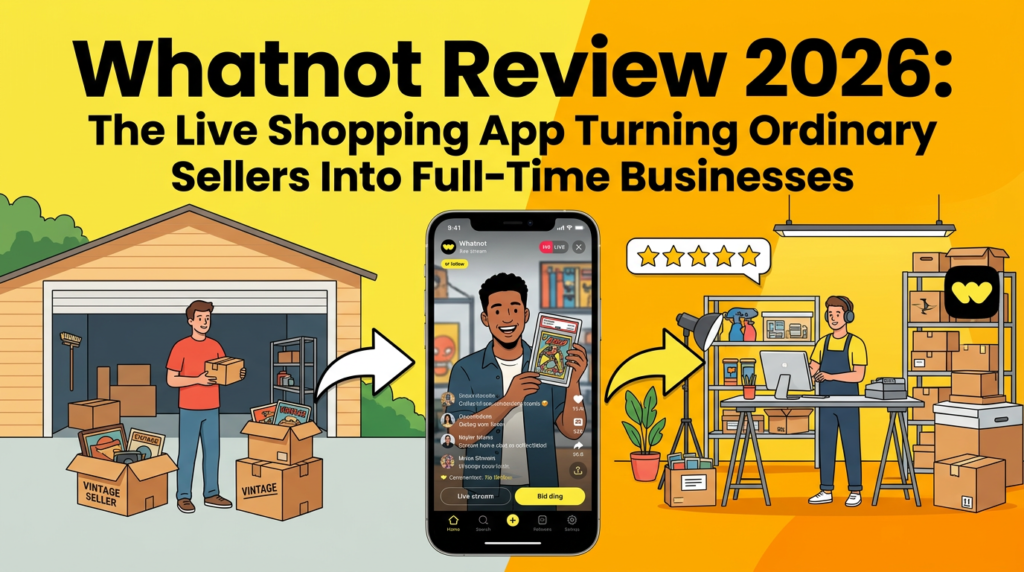
Imagine going live on your phone, showing off a few items from your home, and walking away two hours later having sold thousands of dollars worth of product to an audience that was genuinely excited to buy from you.
That is not a fantasy. That is Tuesday night for thousands of sellers on Whatnot.
Whatnot’s co-founder Grant LaFontaine was the platform’s first live seller, moving $5,000 worth of product in a single two hour stream proof the concept worked from day one. Today, one in eight Whatnot sellers operates full-time, a 20% increase year over year, and sellers who go live three to four times per week average more than $13,000 in monthly sales.
Let that number land. Thirteen thousand dollars a month. From going live on a phone.
This is not a niche hobby platform or an experimental beta. Whatnot raised $265 million in early 2025, bringing its valuation to about $5 billion, and livestream sales on the platform surpassed $3 billion in 2024 more than double the previous year’s total. The platform now operates in the US, UK, and Europe, covering 250+ product categories and having added more than 20 million new user accounts in 2025 alone.
This is a serious business platform. And it is still early enough that getting in now means establishing yourself before the mainstream flood arrives.
This review covers everything how Whatnot works for buyers and sellers, what it costs, what categories are winning, how much you can realistically earn, and how to get started whether you are looking for a fun way to find deals or a genuine income stream.
Ready to join the live shopping revolution? Sign up for Whatnot here Discover live auctions, rare finds, and a shopping experience unlike anything else online.
What Is Whatnot?
At its core, Whatnot is an online platform available as both an app and a website where sellers host live shows, think QVC meets social media, to auction, sell, and showcase items in real time to worldwide shoppers. It is not a static catalogue, but a living, breathing marketplace pulsing with energy.
The simplest description: imagine eBay, but live, interactive, and genuinely entertaining. Instead of clicking through product photos and reading descriptions, you watch a real person on camera show you the item, answer your questions in real time, and run a timed auction where you bid alongside other viewers. The highest bid when the clock runs out wins.
Whatnot marries the thrill of an auction with the interactivity of social media. A host on screen showcases one item at a time, cracking jokes and responding to viewer questions, while a rolling chat and bid buttons beckon you to join the action.
The average Whatnot buyer spends 95 minutes per day on the platform. That is not a shopping session that is appointment viewing. People schedule their evenings around their favorite Whatnot sellers the same way they once scheduled their evenings around television shows.
Whatnot started with trading cards and collectibles, but has expanded into fashion, sneakers, comics, toys, vintage items, beauty products, plants, jewellery, electronics, and hundreds more categories. If you can ship it and talk about it on camera, there is probably an audience for it on Whatnot.
How Does Whatnot Work?
For Buyers – The Shopping Experience
Getting started as a buyer on Whatnot takes less than five minutes.
- Download the Whatnot app (iOS or Android) or sign up at whatnot.com
- Create your account with email or phone number
- Select your interests — the platform curates your live feed based on categories you choose
- Add payment details — card or digital wallet, processed through Stripe
- Browse the live feed and join any stream that catches your attention
- Bid or buy — tap the bid button to enter the auction, or buy at a fixed price when available
Each live event has a set auction timer typically 15 to 60 seconds per item. Bids placed near the end extend the clock slightly, a mechanic sometimes called sudden death that keeps the tension high. The highest bid when the timer expires wins the item. Payment is collected automatically through your stored method, and the seller ships directly to you.
Beyond live auctions, sellers also maintain marketplace listings for Buy It Now purchases — static listings you can shop at any time, even when no show is live. This gives buyers access to their favourite sellers’ inventory 24 hours a day.
What the buying experience actually feels like: What stands out about Whatnot’s live shopping is that sellers are super friendly and engage with you directly. It feels like a fun group party. You also get to see what items look like in real time no more wondering if product photos have been heavily edited.
For Sellers – How to Sell on Whatnot
Selling on Whatnot is more involved than buying, but the potential rewards are proportionally higher.
Step 1 — Apply to become a seller. For trust and safety reasons, you must apply and get approved before you can go live on Whatnot. Approval is based on your niche, type of inventory, and seller history. Sellers must complete a short onboarding quiz. The approval process typically takes a few days.
Step 2 — Build your inventory. List your items into Whatnot’s inventory system before going live. Set starting bids or fixed prices, and organise items into lots or segments for your show.
Step 3 — Schedule and go live. Pick your show time, go on camera, and start selling. Whatnot’s app guides you through running the auction each item queue, bid timer, and chat interaction is handled within the platform.
Step 4 — Ship your sold items. Whatnot provides prepaid shipping labels after each sale, including automatic bundling for shoppers who purchase multiple items in the same show. Sellers must ship within 2 business days.
Step 5 — Get paid. Whatnot releases your payment once buyers confirm receipt, providing protection on both sides of the transaction.
Whatnot Seller Fees – What It Actually Costs
For US sellers, the commission fee is 8% of the sale price for most selling categories, plus a payment processing fee of 2.9% + $0.30 per transaction. Combined, your total platform cost on a typical sale is approximately 10.9–12%.
To put that in context: eBay charges 12–15% in final value fees. Poshmark charges 20% on sales over $15. Amazon takes 15% plus fulfilment fees. At around 12% total, Whatnot is significantly more competitive than selling live on most competing platforms.
What sellers keep: On a $50 sale, Whatnot takes approximately $5.45–$6.00, leaving you $44–$45. On a $200 sale, you walk away with roughly $176–$178. At volume which live selling enables this adds up quickly.
What Sells Best on Whatnot in 2026?
Whatnot covers 250+ categories, from coins to sneakers, fashion to electronics, sports and Pokémon cards to plants, jewellery, and more. But some categories consistently outperform others:
Trading Cards and Collectibles this is where Whatnot was born and it remains the strongest category. Pokémon cards, sports cards, Magic: The Gathering, and other collectible card games generate enormous volume. Box breaks where a group of viewers splits the cost of opening a sealed product box are a uniquely Whatnot format that builds community and sells inventory fast.
Sneakers — Whatnot’s sneaker shows are legendary. One seller parlayed a small collection into a high-volume business with hundreds of live viewers and instant sellouts each week. Rare and limited models sell at strong prices to an audience that genuinely understands their value.
Vintage Fashion and Streetwear – thrifted and vintage clothing, branded streetwear, and curated fashion finds sell consistently. The live format is ideal for fashion because viewers can ask questions about fit, condition, and styling in real time.
Funko Pops and Toys — a core Whatnot category since launch, with dedicated communities of collectors who tune in regularly and spend consistently.
Comics and Memorabilia — vintage comics, signed memorabilia, and sports collectibles find ready buyers in Whatnot’s engaged collector community.
Beauty and Lifestyle — a growing category where brands do product launches, clearance events, and limited drops to highly engaged live audiences.
Plants and Rare Botanicals — one of the platform’s more surprising success stories. Rare and unusual plant sellers have built loyal audiences of enthusiast buyers who tune in weekly.
How Much Can You Realistically Earn on Whatnot?
Let us be direct about the numbers, broken down by commitment level:
Casual seller (1 show per week, 1–2 hours): Moving 15–30 items at an average of $20–$40 each generates $300–$1,200 per show. Monthly: $1,200–$4,800. After Whatnot fees: $1,056–$4,224/month.
Consistent seller (3–4 shows per week): Sellers who go live three to four times per week average more than $13,000 in monthly sales according to Whatnot’s own data. After fees, that is approximately $11,440/month in seller earnings.
Full-time seller (daily shows, established audience): Top sellers on Whatnot generate $50,000–$200,000+ per month in gross sales. These are people who treat it as a full business with inventory management, consistent scheduling, community building, and strong on-camera presence.
The key variable is your on-camera presence. Energy and personality drive sales. The most successful sellers are entertaining, consistent, and passionate about their products not just salespeople. If you are comfortable on camera and genuinely enthusiastic about what you are selling, Whatnot rewards that combination more directly than any other selling platform.
The Whatnot Community -Why It Is Different From Every Other Marketplace
This is the feature that does not show up in the fee comparison charts but matters more than almost anything else.
Whatnot is not about anonymous purchases it is about forming connections. Real-time chat during every show allows jokes, banter, and inside memes. Frequent buyers develop a reputation, get greeted by name, and sometimes score exclusive deals. Deep-dive into subcultures from rare sneakers to vintage toys to Funko Pops and there is a place for every niche.
Whatnot’s growth is host led, not ad led. Compelling hosts attract an audience, the audience recruits more audience, and referral credits encourage first transactions. That combination turns sceptical shoppers into participants.
For sellers, this community dynamic is a significant business advantage. On eBay or Amazon, you are a listing. On Whatnot, you are a personality. Buyers follow you, subscribe to your shows, come back week after week, and bring friends. The community you build is an asset that compounds over time in a way that static marketplace listings never can.
Whatnot’s New Shopify Integration – A Game Changer for Existing Sellers
Whatnot recently launched a direct integration with Shopify that lets Shopify merchants sync products, inventory, and orders automatically to Whatnot, ensuring listings stay accurate and stock is consistent across both platforms.
Previously, Shopify merchants selling on Whatnot had to duplicate their catalogues or manually track inventory across platforms. Now, product details, pricing, condition, variants, and inventory can be managed within a merchant’s Shopify admin, while live shows are run through Whatnot. When a customer makes a purchase, the order is sent back to Shopify, where the merchant manages fulfilment.
Since launching in beta, businesses using this integration around 30 have generated more than $10 million in sales across nearly 20 categories.
If you are already running a Shopify store, this integration makes adding Whatnot as a live selling channel almost frictionless. Your existing inventory syncs automatically. You run your shows on Whatnot. Orders flow back to Shopify. One operation, two revenue streams.
Is Whatnot Legit? Is It Safe?
Whatnot is a legitimate, well-funded, and established platform. The app gets nearly 10 million monthly visitors and holds a 4.3 star rating on Trustpilot from nearly 9,000 reviews.
For buyers: Whatnot uses secure payment processors and does not release payment to sellers until buyers confirm order reception reducing fraud risk significantly. If an item does not arrive, arrives damaged, or is not as described, Whatnot has a structured dispute process: open a claim in the app, upload evidence, and Whatnot mediates. Refunds are available for legitimate cases.
For sellers: Whatnot’s seller verification process including identity checks and category specific onboarding creates a higher-trust environment than open marketplaces. For high-risk categories like luxury handbags or expensive sneakers, Whatnot vets sellers with extra verification and actively removes anyone who breaches community trust.
Honest note on reviews: Considering 7,363 Trustpilot reviews, customers overwhelmingly had positive experiences praising the app, the variety, and the live show atmosphere. However, some customers noted issues with product quality and seller inconsistency. As with any marketplace, the experience varies by seller. Stick to sellers with strong ratings and high review counts for the safest buying experience.
Whatnot vs. The Competition
How does Whatnot stack up against the platforms you already know?
| Feature | Whatnot | eBay | TikTok Shop | Poshmark |
|---|---|---|---|---|
| Format | Live auctions + marketplace | Static listings | Live + static | Static listings |
| Seller fees | ~10–12% | 12–15% | 6–8% | 20% |
| Community | Very strong | Moderate | Growing | Moderate |
| Category focus | Collectibles, fashion, sneakers | Everything | Everything | Fashion |
| Audience engagement | Extremely high (95 min/day) | Low | High | Low |
| Shopify integration | Yes | Partial | Yes | No |
| Seller earnings potential | Very high for live sellers | Moderate | High | Moderate |
While TikTok Shop and Amazon Live emphasise reach and convenience, Whatnot focuses on loyal audiences who tune in and actively contribute to the buying experience. For sellers with niche products and a willingness to show up on camera, Whatnot’s engagement advantage makes it the strongest live selling platform currently operating.
Honest Pros and Cons of Whatnot
What Whatnot Does Exceptionally Well
The income potential is real and documented. Small businesses generated more than $3 billion in sales on Whatnot last year. These are not influencer numbers they are small business numbers from ordinary sellers.
Live format drives faster sales. The ability to move large amounts of inventory in a short time is a major advantage over traditional platforms. Sellers do not have to invest the same time in processing traditional listings, drafting descriptions, and crosslisting.
Built-in audience. Whatnot brings live shoppers to your stream. You do not need to build your traffic from scratch the platform’s existing user base discovers your shows organically.
Shipping is handled end to end. Prepaid labels provided, automatic bundling for multi-item orders, tracking visible in both seller and buyer dashboards.
Competitive fees. At 10–12% total, Whatnot is cheaper than most comparable platforms and significantly cheaper than eBay and Poshmark for comparable products.
Shopify integration. A genuine game changer for existing e-commerce sellers who want to add live selling without rebuilding their operations.
Things to Consider Honestly
You need to be comfortable on camera. This is non-negotiable. Whatnot reviews consistently point to the same conclusion: the platform is powerful but it is not passive. Sellers who are comfortable on camera and can handle a fast-paced environment often see strong results. If going live feels uncomfortable, the learning curve is real.
Seller approval required. You cannot start selling immediately. The application and approval process takes time. Plan your launch timeline accordingly.
Shipping limited to USPS and UPS (US sellers). International shipping options are more limited than some competitors.
Bidding wars can be intense for buyers. Set a budget before joining any live show. Bidding wars are real — the live format creates urgency and FOMO that can push you past what you intended to spend. Discipline is your friend.
Experience varies by seller. Some customers noted issues with inconsistent seller behaviour and product quality. Always check seller ratings and reviews before bidding on high-value items.
Tips for Buyers: How to Get the Best Deals on Whatnot
Follow your favourite sellers. You get notifications when they go live, so you never miss a show. Consistent viewers often get shoutouts, exclusive deals, and early access to premium items.
Be active in chat. Friendly, engaged buyers get noticed. Some sellers offer giveaways or special pricing to their most active chat participants.
Shop off-peak hours. Fewer bidders mean lower final prices. Late night and early morning shows often have less competition.
Check the marketplace between shows. Sellers list Buy It Now inventory at any time. Good deals sit in the marketplace waiting to be found by buyers who look.
Set your budget before you go in. The live format is designed to be exciting. Having a firm limit before the show starts is the simplest way to avoid overspending.
Tips for Sellers: How to Build a Successful Whatnot Business
Be entertaining, not just transactional. Energy and personality drive sales on Whatnot. Host regular shows consistency builds your audience. Offer giveaways they attract more viewers and keep the chat buzzing.
Show up on a schedule. Your audience will build faster if they know when to expect you. Pick two or three consistent time slots per week and stick to them.
Start with what you know and love. Authentic enthusiasm for your products is visible on camera and it converts. Do not start by selling things you have no interest in just because you think they will sell.
Engage with your chat. Read names out loud. Answer questions. Acknowledge new followers. The relationship between sellers and buyers is what keeps people coming back and the chat is where that relationship lives.
Use giveaways strategically. A small free item early in a show attracts viewers and signals generosity. It costs you very little and dramatically increases the energy of the audience.
Leverage the Shopify integration if you have an existing store. Sync your inventory and run Whatnot as an additional live selling channel alongside your existing operations.
Whatnot and Africa – What You Need to Know Before You Sign Up
This section is specifically for TheDiaHub.com readers based across Africa. Before you dive in, here is the honest, verified picture of what Whatnot currently offers to African users.
Can Africans Buy on Whatnot? YES , Most African Countries Can Buy
The good news is clear: Whatnot ships to most countries around the world. For the majority of African countries including Ghana, Nigeria, Kenya, South Africa, Uganda, Rwanda, Zambia, Cameroon, Senegal, and many more you can sign up, browse live shows, bid, win, and have items shipped to your door.
Here is exactly how it works for African buyers:
Shipping time: Shipping typically takes 1–4 weeks for international orders. Some carriers do not guarantee delivery times for international packages, and depending on your country’s postal and customs services, it can take longer. Factor this into your buying decisions — Whatnot is not the right platform if you need something urgently.
Shipping cost: International shipping costs vary by destination and weight. To see the exact shipping cost for Marketplace orders, go into checkout and input your address to see the potential shipping cost. Always check this before committing to a bid, as shipping to Africa from the US can add $20–$60 to your order depending on item size and weight.
Customs and import fees: If your order is shipped internationally, customs, duties, or import fees are charged by your country’s customs agency not by Whatnot or the seller. These fees are the buyer’s responsibility. If you refuse to pay them, the order will not qualify for a refund. Factor in your country’s import duties when calculating the real cost of a purchase — especially for electronics, sneakers, and higher-value items.
Countries currently blocked from buying: As of March 2026, USPS has suspended international shipping to a list of specific countries. African countries on that list include Madagascar, South Sudan, Sudan, Tanzania, Seychelles, Djibouti, and Eritrea. Buyers in these countries cannot currently purchase from US sellers on Whatnot. If you are based in one of these countries, check Whatnot’s help centre for updates as USPS suspensions are lifted periodically.
For buyers in Ghana, Nigeria, Kenya, South Africa, and most of Africa you are clear. Sign up, browse, bid, and buy.
Can Africans Sell on Whatnot? Not Yet But Here Is What to Do
This is the part we have to be honest about. Whatnot currently only accepts sellers located in the United States (including Puerto Rico and US Virgin Islands) and a select list of other countries. Africa is not currently on the approved seller list.
This means if you are based in Ghana, Nigeria, Kenya, South Africa, or anywhere else on the continent, you cannot apply to sell on Whatnot directly from your African address right now.
However — here are three practical paths forward:
Path 1 — Buy as an African, build a resale business locally. Win collectibles, sneakers, vintage fashion, or other items on Whatnot at auction prices, then resell them locally at market value through Jiji, Facebook Marketplace, or your own Instagram shop. Rare Pokémon cards, limited sneakers, and vintage items bought cheaply on Whatnot live auctions can command significant premiums in local African markets where these items are scarce.
Path 2 — Sell through a US-based partner or registered entity. If you have a business partner, family member, or registered entity based in the US, UK, or Canada, they can apply as the seller. You supply the inventory, they run the show, and you split the proceeds. This is how some international entrepreneurs participate in platforms that restrict direct seller access by geography.
Path 3 — Watch the seller programme expansion. Whatnot is actively growing the platform added more than 20 million new users in 2025 and recently launched in Europe. Africa is a natural next frontier. Keep an eye on whatnot.com/sell for any updates to the seller location requirements. Being an early applicant the moment African sellers become eligible gives you a significant first-mover advantage.
The African Buyer Opportunity – Why Whatnot Is Still Worth Joining Now
Even without selling access, Whatnot as a buying platform offers real value for African consumers who are willing to pay international shipping.
Collectibles at auction prices. Rare Pokémon cards, sports memorabilia, Funko Pops, and vintage comics frequently sell on Whatnot for significantly below their secondary market retail value especially in early morning shows with fewer bidders. For African collectors who typically access these items through local importers at marked-up prices, buying directly from Whatnot auctions can represent genuine savings even after shipping.
Sneakers and limited fashion. Limited edition sneakers and streetwear that retail at $120–$200 in the US regularly sell for $40–$80 on Whatnot during live auctions. After international shipping, the total cost can still come in below what the same pair would cost from a local African reseller.
Vintage and unique items. Authentic vintage clothing, jewellery, and homewares are categories where Whatnot’s live format and auction pricing create real opportunities for African buyers who know what they are looking for.
The community itself. Even before making a purchase, spending time watching Whatnot shows teaches you the rhythms of live commerce, the community dynamics, and the product categories that generate the most excitement. This knowledge is directly applicable to building your own live selling presence on African platforms or TikTok Live which has no geographic restriction on sellers.
As a buyer:
- Download the Whatnot app (iOS or Android) or go to whatnot.com
- Create your free account
- Select your interests to personalise your live feed
- Add payment details
- Browse live shows and start bidding
As a seller:
- Create your Whatnot account
- Navigate to the Sell section and submit your seller application
- Complete the onboarding quiz for your chosen category
- Build your initial inventory in the app
- Schedule your first show
- Go live and sell
The entire buyer setup takes under five minutes. Seller approval typically takes a few days. Plan accordingly and use the waiting time to build your inventory and prepare your first show.
Final Verdict: Is Whatnot Worth It in 2026?
For buyers who enjoy an interactive, community-driven shopping experience and love finding deals on collectibles, fashion, sneakers, or rare items Whatnot is genuinely one of the most entertaining and rewarding platforms available.
For sellers who are comfortable on camera, passionate about what they sell, and willing to show up consistently — Whatnot’s income potential is real, documented, and growing. One in eight sellers now operates full-time on the platform. The combination of live urgency, built-in audience, lower fees than most competitors, and a genuinely engaged community creates conditions where motivated sellers thrive.
Whatnot has recreated the thrill of real-world auctions and the camaraderie of shared interests in an online setting — and turned it into a multi-billion-dollar platform that investors value in the eleven-figure range. The growth trajectory is steep and the platform is still expanding.
Getting in now — as a buyer discovering great deals, or as a seller building an audience before the mainstream arrives — is a decision you are unlikely to regret.
Ready to experience live shopping for yourself? Join Whatnot here Sign up free. Browse 250+ categories. Find something you love live, in real time, at auction prices.
Whatnot at a Glance – Quick Reference
| Feature | Details |
|---|---|
| What it is | Live shopping and auction marketplace |
| Founded | 2019 |
| Valuation | ~$5 billion (2025) |
| Annual GMV | $3+ billion (2024) |
| Categories | 250+ |
| Monthly visitors | ~10 million |
| New users added (2025) | 20 million+ |
| Seller fees (US) | 8% commission + 2.9% + $0.30 processing |
| Total seller cost | ~10–12% |
| Shipping | Prepaid labels provided |
| Buyer protection | Yes — dispute system with mediation |
| Shopify integration | Yes — recently launched |
| Available on | iOS, Android, Web |
| Countries | US, UK, Europe |
| Trustpilot rating | 4.3 (9,000+ reviews) |
| Full-time sellers | 1 in 8 (20% increase YoY) |
| Avg monthly sales (3–4 shows/week) | $13,000+ |
Written for TheDiaHub.com practical digital income and side hustle strategies for entrepreneurs everywhere.
This article contains an affiliate link. If you sign up through it, we may earn a commission at no additional cost to you. All opinions are our own based on thorough research of the platform.

Latif Saeed Okwan is a digital entrepreneur from Accra, Ghana helping Africans build real online income through affiliate marketing, AI tools, and digital business. Every method on TheDiaHub.com has been personally researched with the African reality in mind — no hype.